
Last updated: September 7, 2026
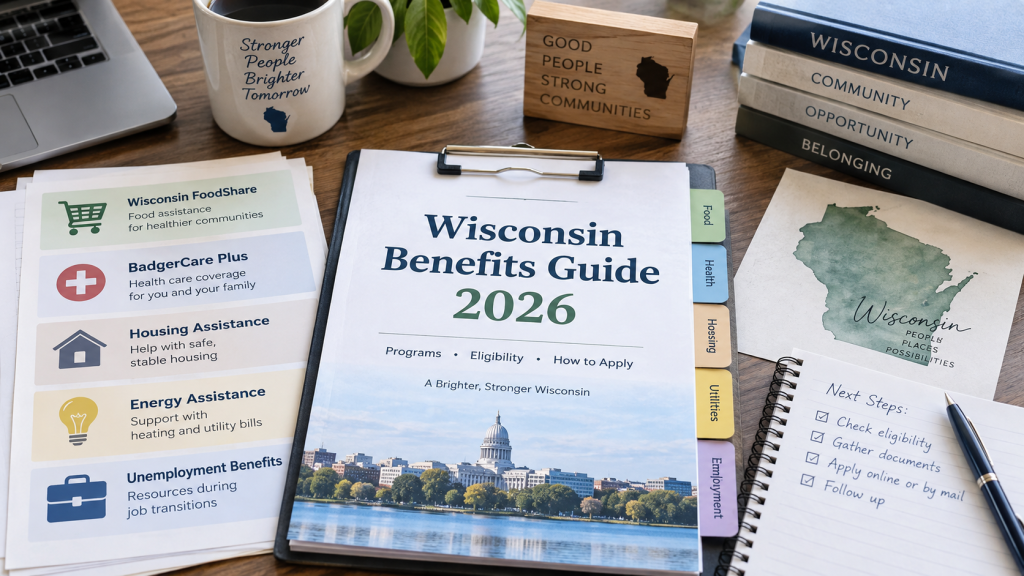
Wisconsin residents may be able to get help with groceries, healthcare,
cash assistance, heating and electric bills, housing costs, or unemployment
through a combination of state and federal programs.
The challenge is that Wisconsin does not use the same name for every program
that people may recognize nationally. SNAP is called FoodShare,
Medicaid coverage for many children and adults is available through
BadgerCare Plus, and Wisconsin’s employment-focused cash
assistance program is called Wisconsin Works, or W-2.
This Wisconsin benefits guide explains the major programs, where to start,
documents you may need, important 2026 changes, and official Wisconsin
resources you can use to verify current information.
Quick Answer:
If you are not sure which Wisconsin program you may qualify for,
a good starting point is Wisconsin’s official benefits system and
Department of Health Services application guidance.
FoodShare, BadgerCare Plus, Medicaid, and several other programs
can be reviewed through Wisconsin’s ACCESS system.
Wisconsin Works (W-2), energy assistance, housing programs,
and unemployment benefits have additional program-specific
requirements and agencies.
Important:
FactBob is an independent informational website and is not affiliated
with the State of Wisconsin or any federal, county, Tribal, or local
government agency.
Benefit amounts, income limits, waiting lists, work requirements,
funding, and application procedures can change.
Always confirm important information with the official agency
responsible for the program before applying.
Wisconsin Benefits Quick Overview
| Program | What It May Help With | Where to Start |
|---|---|---|
| FoodShare | Groceries and food assistance | Wisconsin DHS / ACCESS |
| BadgerCare Plus | Medicaid health coverage | Wisconsin DHS / ACCESS |
| Wisconsin Works (W-2) | Employment services and possible cash assistance | Wisconsin DCF / local W-2 agency |
| WHEAP | Heating and electric bills | Wisconsin Home Energy Plus |
| Housing Choice Voucher / Housing Programs | Rental and affordable housing assistance | WHEDA or local public housing authority |
| Unemployment Insurance | Temporary income after qualifying job loss | Wisconsin DWD |
What I Would Do Before Applying
If I were applying for Wisconsin benefits today, I would first make
a list of every type of help the household needs rather than applying
for only one program.
For example, someone who recently lost a job might want to check
FoodShare, BadgerCare Plus, WHEAP, housing resources, and unemployment
benefits at the same time.
I would then gather recent income information, household details,
rent and utility records, and identification documents before starting.
The part that often creates delays is not the initial application.
It is a later interview, verification request, renewal notice,
or weekly certification that gets missed.
1. ACCESS Wisconsin: A Good Starting Point
Wisconsin uses an online system called ACCESS for
several public benefit programs.
According to the Wisconsin Department of Health Services,
ACCESS can be used to apply for programs such as FoodShare,
BadgerCare Plus, Medicaid, and certain other benefits.
The official Wisconsin DHS application page is:
Wisconsin ForwardHealth — Apply for Benefits
.
The state also directs applicants to the official ACCESS portal at:
ACCESS Wisconsin
.
Information to Have Ready
Wisconsin DHS recommends having information available for each
person who is applying. Depending on the program, this may include:
- Full name and date of birth
- Current address
- Household member information
- Social Security number when required
- Citizenship or immigration information when applicable
- Employment information
- Recent wages and other income
- Information about other health insurance
Additional documents may be required depending on the program
and your individual situation.
2. FoodShare Wisconsin
FoodShare is Wisconsin’s name for the Supplemental Nutrition Assistance
Program, or SNAP.
FoodShare helps eligible households buy food using benefits placed
on a Wisconsin QUEST card.
Wisconsin DHS states that people with low-income jobs,
people living on fixed incomes, retirees, people who have lost jobs,
and people with disabilities may potentially qualify depending on
their circumstances.
Official program information:
FoodShare Wisconsin
.
Application instructions:
FoodShare — How to Apply
.
How to Apply for FoodShare
Wisconsin currently allows FoodShare applications:
- Online through ACCESS
- By phone through the appropriate agency
- In person
- Using a paper FoodShare application
After applying, applicants generally need to complete an interview
with their agency.
Important 2026 FoodShare Work Requirement Update:
Federal changes expanded Wisconsin’s FoodShare work requirement
for some members.
In 2026, the requirement may apply to certain FoodShare members
ages 18 through 64 who do not have a child age 13
or younger living in their home.
A person subject to the requirement generally needs to work,
volunteer, participate in an approved work program, or use
a qualifying combination for at least 80 hours per month.
Exemptions may apply, including certain health situations,
pregnancy, Tribal membership, and other circumstances.
If the requirement applies and the person does not meet it or qualify
for an exemption, FoodShare may generally be limited to three months
during the current three-year period of
January 2025 through December 2027.
Read the current Wisconsin rules here:
Wisconsin FoodShare Work Requirement
.
FoodShare Application Checklist
- Household member information
- Income and employment information
- Housing expenses
- Utility expenses when applicable
- Childcare expenses when applicable
- Medical expenses when applicable
- Requested identity or residency documents
2026 Wisconsin Summer EBT
Official source: Wisconsin DHS Summer EBT questions and answers.
Wisconsin also issued 2026 Summer EBT benefits for qualifying children.
The state reported that benefits were issued to known eligible families
on June 6, 2026.
The 2026 benefit was a one-time $120 per eligible child.
Wisconsin DHS states that the benefit must be spent within 122 days
of the issue date.
Families should check their official notices and current Wisconsin DHS
Summer EBT information rather than assuming every child is automatically eligible.
3. BadgerCare Plus and Wisconsin Medicaid
BadgerCare Plus is a major Wisconsin Medicaid health coverage program
for qualifying residents ages 0 through 64.
It may cover services such as doctor visits, prescriptions,
emergency and urgent care, laboratory services, mental health care,
pregnancy-related care, and other covered medical services.
There is no annual open enrollment period for BadgerCare Plus.
Wisconsin DHS says eligible people can apply throughout the year.
Official information:
Wisconsin BadgerCare Plus
.
2026 BadgerCare Plus Income Update:
Wisconsin’s current BadgerCare Plus income guideline table is effective
from February 1, 2026 through January 31, 2027.
For adults, the guide uses a 100% federal poverty level threshold
for the applicable adult category.
Examples from the current Wisconsin table include:
- 1 person: $1,330.00 per month
- 2 people: $1,803.33 per month
- 3 people: $2,276.67 per month
- 4 people: $2,750.00 per month
Different thresholds apply to children, pregnant people,
and other Medicaid categories.
Do not use the adult table to decide whether a child or pregnant
person qualifies.
See the current official table here:
BadgerCare Plus Income Guidelines
.
BadgerCare Plus Application Checklist
- Household size
- Birth dates
- Current income
- Employer information
- Citizenship or immigration information when required
- Information about employer-sponsored health insurance
- Other health coverage information
Practical Tip:
Do not assume that being over the adult BadgerCare Plus income limit
means every member of the household is ineligible.
Children, pregnant people, older adults, and people applying under
other Medicaid categories can have different eligibility rules.
4. Wisconsin Works (W-2)
Wisconsin Works, commonly called W-2, is Wisconsin’s
employment-focused assistance program for eligible families.
W-2 is not simply a monthly cash benefit program.
The Wisconsin Department of Children and Families describes it as
a program designed to help participants prepare for employment,
develop skills, gain work experience, and build a career path.
Depending on the person’s placement and circumstances,
cash assistance may also be available while preparing for work.
Official program page:
Wisconsin Works (W-2)
.
How to Apply for W-2
Wisconsin currently allows a person to begin a W-2 application
online through ACCESS or by contacting the W-2 agency serving
the area where they live.
To find the correct local office:
Wisconsin W-2 Agency Locator
.
W-2 Application Checklist
- Household and dependent information
- Income information
- Employment history
- Housing information
- Transportation needs
- Childcare needs
- Documents requested by the W-2 agency
2026 Job Access Loan Notice:
Wisconsin’s Job Access Loan program can normally provide qualifying
individuals with a no-interest loan for certain expenses connected
to getting or keeping a job.
However, the Wisconsin Department of Children and Families currently
states that 2026 Job Access Loan funding has been exhausted
and that no new applications were to be accepted after June 29, 2026.
Do not assume that a Job Access Loan is currently available just because
older Wisconsin information describes the program.
Current JAL information:
Wisconsin Job Access Loan
.
5. Wisconsin Home Energy Assistance Program (WHEAP)
The Wisconsin Home Energy Assistance Program, or WHEAP,
helps qualifying households with heating and electric costs.
The program is part of Wisconsin Home Energy Plus and is administered
through Wisconsin’s Division of Energy, Housing and Community Resources
and local agencies.
Official information:
Wisconsin Home Energy Assistance Program
.
2026–2027 WHEAP Program Year
The current WHEAP program year runs October 1, 2026 through September 30, 2027. The income guideline is 60% of Wisconsin’s state median income. For one person, the limit is $3,322 per month or $39,864 annually; larger-household limits appear below. Eligibility does not guarantee a payment if funding is exhausted. Confirm current rules through the official Wisconsin energy-assistance page.
Selected 2026–2027 WHEAP Income Guidelines
| Household Size | Monthly Income | Annual Income |
|---|---|---|
| 1 | $3,322.00 | $39,864 |
| 2 | $4,344.08 | $52,129 |
| 3 | $5,366.25 | $64,395 |
| 4 | $6,388.42 | $76,661 |
These figures apply to the 2026–2027 program year and should not
be used for an earlier or later program year without checking the
current Wisconsin table.
What WHEAP May Help With
WHEAP assistance may include help with heating costs,
electric costs, and certain energy crisis situations.
Wisconsin also operates related Home Energy Plus services,
including programs that may assist eligible households
with certain heating-system or water-heater problems.
For consumer assistance and local resources:
Wisconsin Energy and Housing Assistance
.
WHEAP Checklist
- Household member information
- Income documentation
- Current heating bill
- Electric bill
- Utility account information
- Proof of residence when requested
- Any shutoff or crisis notices
6. Wisconsin Housing Assistance
Housing help in Wisconsin is more complicated than programs such
as FoodShare because housing assistance is often administered through
multiple housing authorities and local organizations.
The Housing Choice Voucher program, often called Section 8,
helps eligible low-income households, seniors, and people with
disabilities afford qualifying rental housing.
Wisconsin Housing and Economic Development Authority
(WHEDA) administers vouchers in certain service areas,
while other local public housing authorities operate separate programs.
Important Wisconsin Housing Waiting List Notice:
WHEDA currently states that its
Tenant-Based Housing Choice Voucher waiting lists have been closed
since April 8, 2025 and that new applications are not being
accepted at this time.
Current exceptions include qualifying Veterans Affairs Supportive Housing
(VASH) referrals and certain Project-Based Voucher properties in
Hartford, Manitowoc, Chilton, and Oconto.
A closed WHEDA list does not necessarily mean that every housing authority
or affordable housing program in Wisconsin is closed.
Check the housing authority serving your specific city or county.
Current WHEDA information:
WHEDA Housing Choice Voucher Applicants
.
You can also use HUD’s Wisconsin page to locate housing resources
and public housing authorities:
HUD Wisconsin
.
Housing Application Checklist
- Household member information
- Income and asset information requested by the program
- Current address
- Rental or lease information
- Identification documentation
- Disability or preference documentation when applicable
- Updated phone number and mailing address
Housing Tip:
Do not rely on a search result that simply says “Section 8 applications open.”
Check the actual housing authority or WHEDA page and confirm the
waiting-list status before entering personal information.
Housing waiting lists can open or close independently.
7. Wisconsin Unemployment Benefits
Wisconsin Unemployment Insurance provides temporary benefits
to eligible workers who meet the state’s unemployment requirements.
The Wisconsin Department of Workforce Development, or DWD,
manages the program.
Official unemployment page:
Wisconsin Unemployment Insurance
.
To start a new claim:
Apply for Wisconsin Unemployment Benefits
.
2026 Wisconsin Unemployment Reminder:
Filing the initial unemployment application is not the end
of the process.
Wisconsin generally requires claimants who are not exempt or waived
to complete at least four work-search actions each week.
Claimants should document those activities through the Claimant Portal
or have the information ready when filing the weekly claim.
Wisconsin also requires a weekly claim for each week for which
a person wants an unemployment payment.
The state currently gives claimants up to 14 days
to file a weekly claim for a particular week.
Current work-search rules:
Wisconsin Work Search Requirements
.
Weekly claim information:
File a Wisconsin Weekly Claim
.
Unemployment Checklist
- Social Security number and identity information
- Employer information
- Employment dates
- Reason employment ended
- Wage information when requested
- Work-search records
- Weekly earnings if working part time
Common Reasons Wisconsin Benefit Applications Can Be Delayed
Different programs have different eligibility systems, but several
problems can create delays across multiple benefit programs.
- Missing requested verification documents
- Missing a FoodShare interview
- Using outdated income information
- Failing to report a household change when required
- Missing a renewal or eligibility review
- Not updating your mailing address
- Missing W-2 appointments or required activities
- Failing to file unemployment weekly claims
- Failing to document required unemployment work searches
- Applying to a housing waiting list that is already closed
Complete Wisconsin Benefits Application Checklist
Not every program requires every item on this list.
However, having these records organized before applying can make
the process easier.
- Photo identification when required
- Social Security information when required
- Birth dates for household members
- Current home address
- Recent pay stubs
- Employer contact information
- Social Security or unemployment income information
- Other household income
- Rent or mortgage information
- Utility bills
- Childcare expenses
- Medical expenses when relevant
- Current health insurance information
- Lease or housing documents when applying for housing help
- Job-search records for unemployment
- Copies of agency notices and letters
Practical Tip: Keep a Benefit Paper Trail
One thing I would do from the beginning is keep a simple folder,
either on paper or digitally, for every benefit application.
Save:
- The date you applied
- Application confirmation numbers
- Documents you uploaded
- Letters from the agency
- Dates and names from important phone calls
- Interview appointments
- Renewal deadlines
- Weekly unemployment certifications
- Work-search records
If something goes wrong later, having a record of what you submitted
and when you submitted it can make it much easier to understand
what happened.
Frequently Asked Questions
Is FoodShare the same as SNAP in Wisconsin?
Yes. FoodShare is Wisconsin’s name for the federal Supplemental
Nutrition Assistance Program, commonly known as SNAP.
Can I apply for FoodShare and BadgerCare Plus together?
Wisconsin’s ACCESS system allows applicants to apply for multiple
benefit programs through the state’s application process.
Your eligibility is determined separately for each program.
Can I apply for BadgerCare Plus at any time?
Yes. Wisconsin DHS states that BadgerCare Plus does not have
an annual open enrollment period. You can apply during the year
and the state will determine whether you qualify.
Does every adult on FoodShare have to work 80 hours per month?
No. The FoodShare work requirement applies only to people who meet
the applicable criteria, and exemptions are available.
Wisconsin’s agency determines whether the requirement applies
to a particular person.
Is Wisconsin W-2 just cash assistance?
No. Wisconsin Works is primarily an employment and workforce
support program. Depending on a participant’s circumstances
and placement, cash assistance may also be available.
Can I still apply for a Wisconsin Job Access Loan in 2026?
Wisconsin DCF currently states that 2026 Job Access Loan funding
has been exhausted and that new applications were no longer
accepted after June 29, 2026.
Is the WHEDA Section 8 waiting list open?
WHEDA currently reports that its tenant-based Housing Choice Voucher
waiting lists are closed to new applications, with limited exceptions
including certain VASH referrals and specific Project-Based Voucher properties.
Other local housing authorities may have different waiting-list statuses.
How many job-search activities are required for Wisconsin unemployment?
Wisconsin currently generally requires at least four qualifying
work-search actions per week unless DWD has granted an applicable waiver
or another exception applies.
When does the new 2026–2027 WHEAP year begin?
Wisconsin’s 2026–2027 WHEAP program year begins October 1, 2026
and runs through September 30, 2027.
Related State Guides
-
Michigan Benefits Guide 2026
-
Illinois Benefits Guide 2026
-
Indiana Benefits Guide 2026
-
Missouri Benefits Guide 2026
-
Browse All State Benefit Guides
Official Wisconsin and Federal Resources
-
Wisconsin Benefits Application Information:
Wisconsin ForwardHealth — Apply for Benefits
-
FoodShare Wisconsin:
Wisconsin Department of Health Services
-
FoodShare Application:
FoodShare — How to Apply
-
FoodShare Work Requirement:
Wisconsin DHS Work Requirement Information
-
BadgerCare Plus:
Wisconsin BadgerCare Plus
-
BadgerCare Plus Income Guidelines:
Current Wisconsin Income Guidelines
-
Wisconsin Works (W-2):
Wisconsin Department of Children and Families
-
Find a W-2 Agency:
Wisconsin W-2 Agency Locator
-
Wisconsin Home Energy Assistance:
Wisconsin WHEAP
-
Housing Choice Voucher:
WHEDA HCV Applicants
-
HUD Wisconsin:
HUD Wisconsin Housing Resources
-
Wisconsin Unemployment Insurance:
Wisconsin Department of Workforce Development
-
Apply for Unemployment:
Wisconsin Unemployment Application
-
Weekly Unemployment Claim:
File a Weekly Claim
Disclaimer
This Wisconsin benefits guide is provided for general informational
purposes only.
FactBob is not a government agency and does not determine eligibility,
process applications, issue benefits, manage housing waiting lists,
or provide legal, financial, medical, or tax advice.
Program rules, income limits, work requirements, benefit availability,
housing waiting lists, application procedures, and funding can change.
Always verify important information directly with the appropriate
Wisconsin or federal agency before applying or making a decision.
Final Thoughts
Wisconsin has several major assistance programs, but the correct starting
point depends on what kind of help you need.
For food and healthcare benefits, Wisconsin’s DHS and ACCESS system
are usually the most useful starting points. Families looking for
employment-focused assistance can also check Wisconsin Works.
Households struggling with energy costs should review WHEAP,
while renters should check WHEDA and their local public housing authority.
If you recently lost work, remember that filing an unemployment application
is only the first step. Weekly claims and work-search requirements can be
just as important as the initial filing.
Most importantly, use current official Wisconsin resources rather than
relying on an old income table, an outdated waiting-list notice,
or a third-party application website.


Pingback: Colorado Benefits Guide 2026: SNAP, Medicaid, Cash, LEAP, Housing, Unemployment