Last updated: July 14, 2026
This Illinois benefits guide is for people who need a clear starting point for food assistance, health coverage, children’s health insurance, cash assistance, utility bill help, housing resources, and unemployment benefits in Illinois.
Illinois benefits can feel confusing because several programs overlap, but they are not always handled the same way. SNAP, cash assistance, and medical assistance are connected to the Illinois Department of Human Services. Medicaid and All Kids are administered through Illinois Healthcare and Family Services. Utility bill assistance is handled through Illinois LIHEAP and local administering agencies. Housing assistance may involve IHDA, HUD, or a local public housing agency. Unemployment benefits are handled separately by the Illinois Department of Employment Security.
In real life, the hardest part is usually not finding the name of a benefit. The trouble often starts after the application: a pay stub is missing, a document photo is blurry, an old mailing address is still on file, a letter is opened too late, or an unemployment certification date is missed.
The practical lesson is simple: before you apply, gather your documents and decide where you will keep your records. A folder on your phone or computer with screenshots, confirmation numbers, notices, and uploaded documents can make a frustrating process much easier to manage.
Illinois Benefits Guide: Quick Answer
If you live in Illinois and need help with food, medical coverage, cash assistance, utility bills, housing, or unemployment, start with the official agency responsible for that program.
For SNAP, cash, and medical assistance, start with the Illinois Department of Human Services Cash, SNAP & Medical Assistance page.
The State of Illinois normally uses Application for Benefits Eligibility, or ABE, for online benefits applications and case management. However, at the time this guide was updated, the official ABE page displayed a temporary service outage. If the system is still unavailable when you visit, follow the official IDHS instructions for applying by paper application, through a local Family Community Resource Center, or by phone.
For Medicaid information, check Illinois HFS Applying for Medicaid. For children’s health coverage, check Illinois All Kids. For utility assistance, check Illinois LIHEAP How to Apply. For unemployment, start with IDES File an Unemployment Claim.
Current service note: ABE and Manage My Case were displaying a temporary unavailability notice when this guide was updated. Online service status can change, so check ABE first. If it remains unavailable, use the current IDHS paper application, local Family Community Resource Center, or phone application instructions.
Important: This Illinois benefits guide does not decide eligibility. Income limits, application methods, program funding, deadlines, waiting lists, documents, and eligibility rules can change. Always confirm current information with the official Illinois agency, federal agency, or local provider before applying.
Quick Overview of Illinois Benefit Programs
| Need | Program or Resource | Where to Start |
|---|---|---|
| Food help | SNAP | IDHS / ABE when available |
| Health coverage | Illinois Medicaid | Illinois HFS / IDHS |
| Children’s health coverage | All Kids | Illinois HFS |
| Cash help | Cash Assistance | IDHS / ABE when available |
| Utility bills | LIHEAP | Illinois DCEO / Local agency |
| Rent or housing | Affordable housing, Section 8, public housing | IHDA / HUD / Local PHA |
| Job loss | Unemployment Insurance | Illinois Department of Employment Security |
What You Can Do Today
- Check the current ABE system status before trying to apply online.
- If ABE is unavailable, use the official IDHS paper, phone, or local office application options.
- Gather income, household, rent, utility, and identity documents before applying.
- Check Illinois HFS separately for Medicaid and All Kids information.
- Check LIHEAP now if you need utility help because the current application period is scheduled to end August 15, 2026, or earlier if funding is exhausted.
- Contact a local public housing agency for Housing Choice Voucher applications instead of assuming IHDA takes every Section 8 application.
- If you file for unemployment, mark your certification dates on a calendar.
- Save every confirmation number, notice, document upload, and phone call date.
1. SNAP Food Assistance in Illinois
SNAP helps eligible households buy food. In Illinois, SNAP applications and case services are connected to the Illinois Department of Human Services.
Normally, many applicants use ABE to apply for SNAP, medical assistance, and cash assistance. However, because the official ABE page was temporarily unavailable when this guide was updated, applicants should check the current system status before relying only on the online portal.
If ABE is still unavailable, IDHS provides other official options. You can download a paper application, submit it to a local Family Community Resource Center, apply at a local office, or contact the IDHS help line for application assistance.
This is one of those situations where checking the official page first can save time. It is frustrating to spend twenty minutes trying to log into a system that is temporarily down when the state is already providing another application route.
Another practical issue is document preparation. People often begin an application and only then realize that they do not know the exact monthly rent, current gross income, or utility costs. Gather those details before you start.
SNAP checklist before applying
- Names and dates of birth for household members
- Proof of identity
- Proof of Illinois residence
- Recent pay stubs or other income records
- Rent or mortgage information
- Utility expenses
- Social Security numbers for applicants who have them
- Child care expenses, if relevant
- Medical expenses for elderly or disabled household members, if relevant
Common SNAP issues to watch for
- Starting an online application while ABE is temporarily unavailable
- Household information does not match current circumstances
- Income information is outdated or incomplete
- Required documents are missing
- An interview or verification request is missed
- The applicant does not check mail or phone messages from IDHS
- A mailing address or phone number is outdated
Official starting points:
- IDHS Cash, SNAP & Medical Assistance
- Illinois ABE and Current System Status
- IDHS Office Locator
- USA.gov SNAP Information
2. Illinois Medicaid
Illinois Medicaid provides health coverage to eligible Illinois residents. The Illinois Department of Healthcare and Family Services provides official information about applying for and using Medicaid.
Illinois HFS normally lists several ways to apply for Medicaid: online, by phone, in person, or with a paper application. The same ABE system is normally used for online Medicaid, SNAP, and cash assistance applications.
Because ABE was temporarily unavailable when this guide was updated, do not assume that a login problem means you cannot apply. Check the official service status and use the current phone, paper, or Family Community Resource Center options if necessary.
One practical thing that helps is keeping your application tracking or case number. When a process takes longer than expected, having that number makes it easier to ask about the status without starting over.
Illinois HFS also warns against submitting another Medicaid application just because the first one is taking time. Duplicate applications can create additional confusion. Check the status of the original application first.
Medicaid checklist before applying
- An address where you can reliably receive mail
- Full names and dates of birth for household members
- Social Security numbers for applicants who have them
- Immigration documents or registration numbers, if applicable
- Household income information
- Current health insurance information, if any
- Financial resource information when required for the applicant’s Medicaid category
- Pregnancy information, if applicable
- Disability or medical information, if applicable
Common Medicaid problems to watch for
- Requested documents are not returned by the deadline
- The state cannot verify information electronically
- A mailing address or phone number is outdated
- The applicant submits a second application instead of checking the first application
- A renewal or redetermination notice is missed
- The applicant does not keep the tracking or case number
Official starting points:
- Illinois HFS Applying for Medicaid
- Illinois HFS After Applying for Medicaid
- IDHS Cash, SNAP & Medical Assistance
- Illinois ABE and Current System Status
- Healthcare.gov Medicaid and CHIP
- USA.gov Medicaid and CHIP
3. All Kids Health Coverage in Illinois
All Kids is Illinois’ health coverage program for children. The official Illinois HFS information says children may qualify if they live in Illinois, are age 18 or younger, meet the insurance requirements, and meet the applicable family income rules.
This is a program worth checking even when a parent does not qualify for the same health coverage. Children’s eligibility can be different from adult eligibility.
A common mistake is looking at an adult Medicaid result and assuming it automatically answers the question for every child in the household. It may not. Check All Kids separately when a child needs coverage.
All Kids checklist before applying
- Child’s full name and date of birth
- Proof that the child lives in Illinois
- Household income information
- Current health insurance information, if any
- Parent or guardian contact information
- Requested citizenship or immigration-related information, when applicable
Official starting points:
4. Cash Assistance in Illinois
Illinois residents who need temporary cash help can start with the Illinois Department of Human Services Cash, SNAP & Medical Assistance page.
Cash assistance is separate from SNAP. SNAP is primarily food assistance, while cash assistance has its own eligibility rules and follow-up requirements.
The practical problem is that applicants sometimes assume submitting the first form is the end of the process. It may not be. IDHS may request an interview or additional documents depending on the application and household situation.
If you receive a request for more information, write the deadline somewhere you will actually see it. A phone calendar reminder is often more useful than leaving a paper notice on a table and hoping you remember it.
Cash assistance checklist before applying
- Proof of identity
- Proof of Illinois residence
- Household member information
- Income records
- Information about children in the household, if relevant
- Rent and household expense information
- Employment information, if requested
- Social Security numbers for applicants who have them
Common reasons cash assistance may be delayed or denied
- Income or resources do not meet program requirements
- Documents are incomplete or unreadable
- Household information is incomplete
- A required interview or appointment is missed
- Additional verification is not returned by the deadline
- The applicant does not respond to an IDHS notice
Official starting points:
- IDHS Cash, SNAP & Medical Assistance
- Illinois ABE and Current System Status
- IDHS Office Locator
- USA.gov TANF and Welfare Benefits
5. LIHEAP Utility Bill Assistance in Illinois
LIHEAP is the Low Income Home Energy Assistance Program. In Illinois, the program helps eligible low-income households with home energy costs and is administered through the Illinois Department of Commerce and Economic Opportunity and local agencies.
For the current program year, the official Illinois page lists the LIHEAP application period as October 1, 2025 through August 15, 2026, or until funding is exhausted.
That timing matters. Waiting until the final weeks of a program period or until a shutoff date is very close can make the process more stressful. If you need help, check your local agency as early as possible.
Illinois allows people to submit a Request for Services and also apply through a local administering agency. The official guidance says that if you have a disconnect notice, a disconnect date, or service is already disconnected, you should contact your county agency directly.
One useful practical step is to keep your utility account number and most recent bill ready before you make the call. It saves time when someone asks which company provides service and whose name is on the account.
LIHEAP checklist before applying
- Current utility or energy bill
- Utility account information
- Disconnect notice, if any
- Proof of household income
- Proof of Illinois residence
- Household member information
- Identification documents requested by the local agency
- Proof that you are responsible for the energy cost
Current LIHEAP cautions
- The current application period is scheduled through August 15, 2026, or until funding is exhausted.
- Local agencies handle applications, so the correct agency depends on your county.
- Funding and appointment availability can change.
- If you have an urgent disconnect situation, contact the local agency directly.
- PIPP is not accepting new applications during the current October 1, 2025 through August 15, 2026 period, although traditional LIHEAP assistance remains available subject to eligibility and funding.
Official starting points:
- Illinois Utility Bill Assistance
- Illinois LIHEAP How to Apply
- Illinois Utility Bill Assistance FAQ
- USA.gov Help With Utility Bills
6. Housing Assistance and Section 8 in Illinois
Housing assistance in Illinois can involve the Illinois Housing Development Authority, HUD, local public housing agencies, participating properties, and local nonprofit or community programs.
This is one of the areas where people often lose time because they search for one statewide Section 8 application. There is not one simple statewide application that covers every situation.
IHDA provides rental housing resources and administers several housing programs. However, IHDA specifically states that it does not issue or accept applications for the general Housing Choice Voucher program. For Housing Choice Vouchers, you should contact a public housing agency in your community.
That distinction matters. If you spend days repeatedly checking the wrong agency, you may miss an open local waiting list.
If you need affordable housing rather than a voucher specifically, IHDA also provides information about affordable rental housing, participating properties, and other rental assistance programs.
Housing checklist before contacting a program
- Photo ID
- Household member information
- Proof of income
- Current lease or rental agreement
- Current rent amount
- Past-due rent notice, if any
- Eviction notice or court paperwork, if any
- Disability, senior, or veteran information, if relevant to a specific program
Common housing assistance problems
- A Housing Choice Voucher waiting list is closed
- The applicant contacts IHDA for a voucher application that must be handled by a local PHA
- The household is outside the program’s service area
- The applicant misses a waiting list update notice
- Required household or income documents are incomplete
- The applicant relies on an old emergency rental assistance program that is no longer accepting applications
Official starting points:
- IHDA Rental Housing Resources
- HUD Illinois
- HUD Public Housing Agency Contacts
- USA.gov Rental Assistance
7. Unemployment Benefits in Illinois
Illinois unemployment insurance is handled by the Illinois Department of Employment Security, commonly called IDES.
One of the easiest mistakes to make is assuming that filing the original claim is the only step. It is not. IDES explains that certification is how eligible claimants are paid benefits, and regular unemployment claimants certify every other week.
The official IDES certification page says claimants should certify on their designated certification day. Thursday and Friday are listed as make-up days if the assigned day is missed.
This is exactly the kind of deadline that is easy to forget when someone is already dealing with job loss. As soon as you receive your assigned schedule, put the certification date in your phone calendar and set a reminder.
Unemployment checklist before filing
- Social Security number
- Recent employer name and address
- Dates you worked
- Reason employment ended
- Wage information
- Current mailing address and phone number
- Information about any work performed while claiming benefits
- Work search records when required
Common unemployment issues to watch for
- Employer information is incomplete
- The reason for separation is unclear
- A request from IDES is not answered
- The claimant forgets to certify every other week
- The designated certification day is missed
- Wages or work activity are not reported correctly
- Required employment service or work search steps are not completed
Official starting points:
- IDES File an Unemployment Claim
- IDES Certify for Benefits
- IDES 10 Things You Should Know
- USA.gov Unemployment Benefits
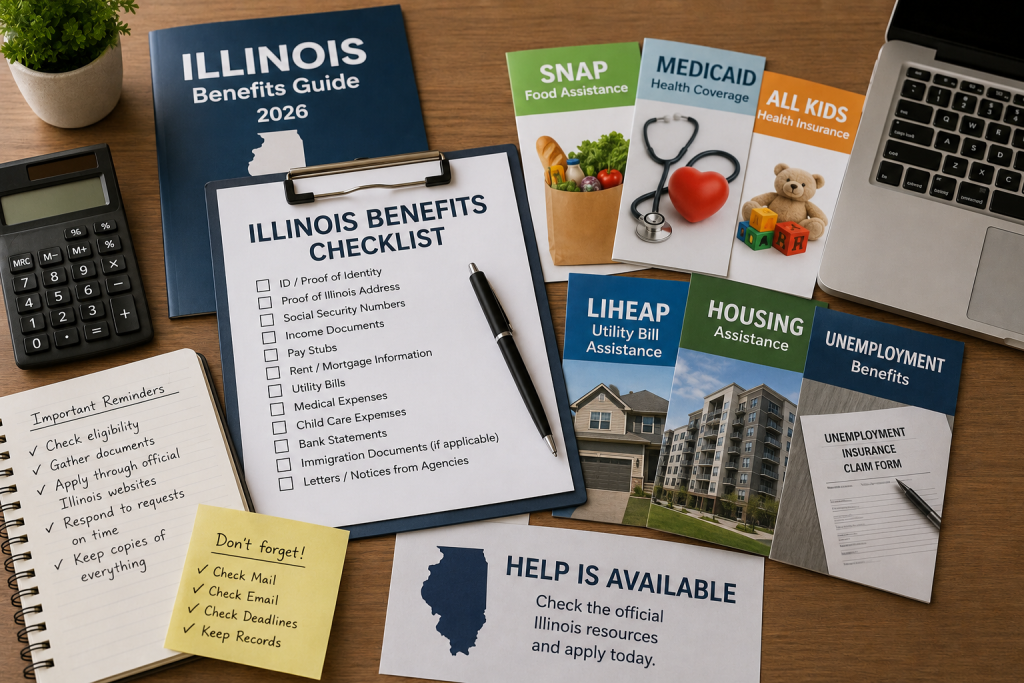
Illinois Benefits Guide Application Checklist Before You Start
Before applying for an Illinois benefit, gather the documents that are most likely to be requested. You may not need every item for every program, but having them ready can make follow-up much easier.
- Photo ID or other identification
- An address where you can reliably receive mail
- Social Security numbers for applicants who have them
- Names and dates of birth for household members
- Recent pay stubs or other income records
- Rent or mortgage documents
- Utility bills
- Health insurance information
- Bank or resource information when required by the specific program
- Medical expenses, if relevant
- Child care expenses, if relevant
- Immigration documents, if applicable and requested
- Previous benefit notices
- Application confirmation or tracking numbers
Common Reasons Illinois Benefit Applications Get Delayed or Denied
A delay or denial does not always mean there is nothing else you can do. Sometimes the problem is a missing document, a missed deadline, a system outage, or an application sent through the wrong channel.
- Income does not meet the program rules
- Household information is incomplete or incorrect
- Documents are missing
- Uploaded documents are blurry or unreadable
- A verification request is missed
- An interview or appointment is missed
- The mailing address or phone number is outdated
- A renewal or redetermination deadline is missed
- The applicant uses an unavailable online system without checking alternative application methods
- A housing program or waiting list is closed
- LIHEAP funding or the application period is no longer available
- An unemployment certification date is missed
Practical Tip: Keep a Benefit Paper Trail
Keep one folder for everything related to your application. Save screenshots, confirmation numbers, tracking numbers, uploaded documents, letters, emails, and notices.
If you call an office, write down the date, the phone number, and what you were told. If you submit a document, keep a copy. If you receive a notice with a deadline, put the deadline in your phone calendar immediately.
It may feel unnecessary when the application is going smoothly, but this record becomes extremely useful if a document goes missing, the case is delayed, or you need to explain when something was submitted.
Frequently Asked Questions
Is Illinois ABE currently working?
At the time this guide was updated, the official ABE page displayed a notice that ABE and Manage My Case were temporarily unavailable. Check the official ABE page for the latest status. If the outage continues, use the current IDHS instructions for paper applications, local Family Community Resource Centers, or phone assistance.
Can I still apply for SNAP if ABE is unavailable?
Yes. The official IDHS Cash, SNAP & Medical Assistance page provides paper application, local Family Community Resource Center, and phone assistance options. Check the current instructions before applying.
Can I apply for SNAP, cash assistance, and medical assistance together?
Illinois normally allows applicants to use the same benefits application process for multiple programs. When ABE is available, applicants can select the benefits they want to apply for. During an online outage, follow the current IDHS application instructions.
Should I submit another Medicaid application if my first application is taking a long time?
Illinois HFS advises applicants not to automatically submit another application simply because the first one is taking longer than expected. A duplicate application can create additional confusion. Check the status of the existing application first.
Can my child qualify for All Kids if I do not qualify for Medicaid?
Possibly. Children’s health coverage rules are not always the same as adult eligibility rules. Check the official All Kids eligibility information separately.
Is Illinois LIHEAP still accepting applications?
The current official Illinois schedule lists the application period as October 1, 2025 through August 15, 2026, or until funding is exhausted. Because funding can run out, check the official page and your local agency before assuming assistance is still available.
Does IHDA accept Section 8 Housing Choice Voucher applications?
IHDA states that it does not issue or accept applications for the general Housing Choice Voucher program. To apply for a Housing Choice Voucher, contact a public housing agency in your community.
How often do I certify for regular unemployment benefits in Illinois?
IDES says regular unemployment claimants certify every other week. Follow the certification schedule assigned to your claim and check the official IDES instructions.
What should I do if my application is denied?
Read the decision notice carefully. Look for the reason, the deadline, and any instructions for providing missing information, requesting a review, filing an appeal, or reapplying. Keep the notice and copies of everything you previously submitted.
Related Guides
- Georgia Benefits Guide 2026
- New York Benefits Guide 2026
- Florida Benefits Guide 2026
- Texas Benefits Guide 2026
- California Benefits Guide 2026
- Browse All State & Local Guides
Official Illinois and Federal Resources
- Illinois ABE — Official Illinois benefits portal and current system status.
- IDHS Office Locator — Find a local Family Community Resource Center or other IDHS office.
- Illinois HFS Applying for Medicaid — Official Medicaid application information.
- Illinois HFS After Applying for Medicaid — Application status, document requests, approval, denial, and follow-up information.
- Illinois All Kids — Official children’s health coverage information.
- About All Kids — Current basic eligibility information.
- All Kids Application — Official application options and contact information.
- Illinois Utility Bill Assistance — Official LIHEAP and energy assistance information.
- Illinois LIHEAP How to Apply — Current application period and application instructions.
- Illinois Utility Bill Assistance FAQ — Current LIHEAP and PIPP program information.
- IHDA Rental Housing Resources — Affordable rental housing and rental assistance resources.
- IDES File an Unemployment Claim — Official Illinois unemployment claim starting point.
- IDES Certify for Benefits — Official unemployment certification information.
- IDES 10 Things You Should Know — Important information before and after filing an unemployment claim.
- USA.gov SNAP Information — Federal SNAP overview and state application guidance.
- Healthcare.gov Medicaid and CHIP — Federal health coverage information.
- USA.gov Medicaid and CHIP — Federal Medicaid and CHIP application guidance.
- USA.gov TANF and Welfare Benefits — Federal information about temporary cash assistance.
- USA.gov Rental Assistance — Federal guide to rental assistance, public housing, and Housing Choice Vouchers.
- USA.gov Help With Utility Bills — Federal guide to utility assistance.
- USA.gov Unemployment Benefits — Federal guide to state unemployment programs.
Disclaimer
FactBob is an independent informational website. We are not a government agency, and we do not process benefit applications, decide eligibility, provide legal advice, or guarantee benefits.
Program rules, application systems, funding, waiting lists, deadlines, documents, and eligibility requirements can change. Always confirm current details with the official Illinois agency, federal agency, local public housing agency, or other authorized provider before applying.
Final Thoughts
This Illinois benefits guide is meant to help you avoid one of the most common problems: starting in the wrong place or relying on an application method that is temporarily unavailable.
For SNAP, cash assistance, and medical assistance, start with IDHS and check the current ABE status. For Medicaid, use Illinois HFS information. For children’s coverage, check All Kids. For utility assistance, check LIHEAP before the current program period or funding ends. For Housing Choice Vouchers, contact a local public housing agency. For unemployment, file through IDES and remember that certification continues after the initial claim.
The application itself is only part of the process. The part that often makes the biggest difference is what happens afterward: checking your mail, answering calls, responding to document requests, saving confirmation numbers, and watching deadlines.
Start with the program that matches your most urgent need, use the official source, and keep a record of every step.