
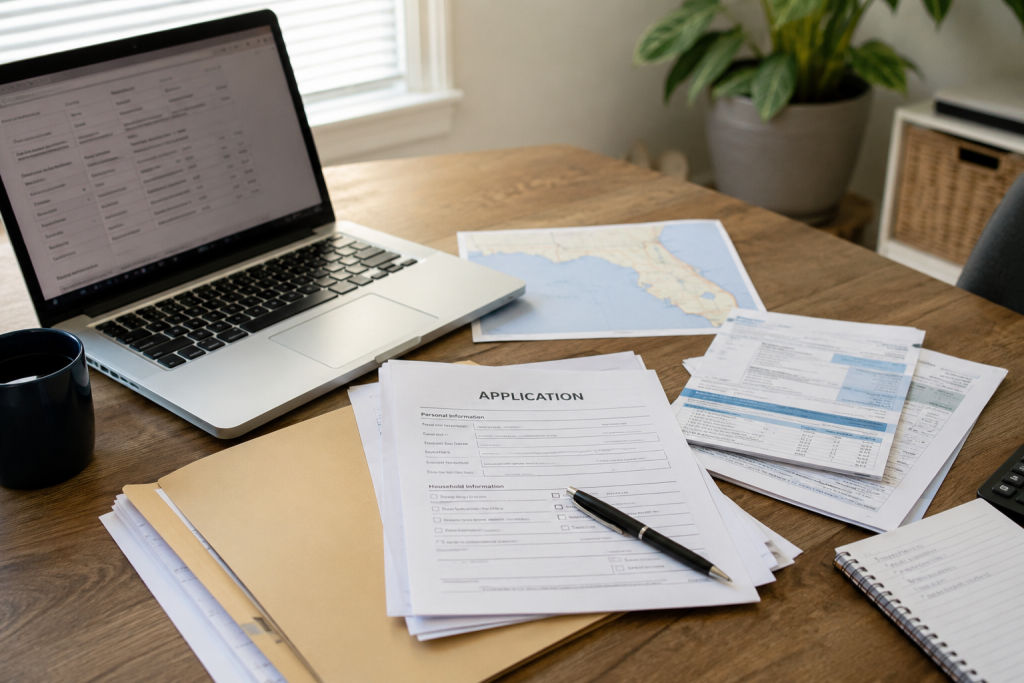
Last updated: July 9, 2026
This Florida benefits guide is for people who need a clear starting point for food assistance, health coverage, children’s health insurance, housing help, utility bill support, unemployment resources, and temporary cash help in Florida.
Florida benefits can feel confusing at first because everything is not handled by one single office. SNAP, Medicaid eligibility, and Temporary Cash Assistance are connected to the Florida Department of Children and Families. Children’s health coverage may involve Florida KidCare. Housing and utility help are often local, so 2-1-1 Florida, HUD, and county-level providers can matter just as much as state pages.
Florida Benefits Guide: Quick Answer
If you live in Florida and need help with food, health coverage, cash assistance, rent, utility bills, or local support, start with the Florida DCF Public Assistance page.
For children’s health insurance, check Florida KidCare. For local rent, food, shelter, utility, or community help, use Florida 211. If you are not sure where to begin, start with those three pages and keep notes as you go.
Important note: This Florida benefits guide does not decide eligibility. Program rules, income limits, funding, documents, deadlines, and local availability can change. Always confirm details with the official Florida agency, federal resource, or local provider before applying.
Quick Overview of Florida Benefit Programs
| Need | Program or Resource | Where to Start |
|---|---|---|
| Food help | SNAP Food Assistance | Florida DCF / USA.gov SNAP |
| Health coverage | Florida Medicaid | Florida DCF Medicaid / Healthcare.gov |
| Children’s health coverage | Florida KidCare / CHIP | Florida KidCare |
| Cash help for families | Temporary Cash Assistance | Florida DCF |
| Rent or housing help | Rental assistance, Section 8, public housing, local housing help | Florida 211 / HUD / USA.gov |
| Utility bills | Energy, phone, internet, and local utility resources | Florida 211 / USA.gov Utility Help |
| Job loss | Unemployment resources | USA.gov Unemployment Benefits |
What You Can Do Today
- Check the Florida DCF Public Assistance page before starting a SNAP, Medicaid, or Temporary Cash Assistance application.
- Use Florida KidCare if you are looking for health or dental coverage for a child.
- Use Florida 211 if your need is local, such as rent help, food pantry help, emergency shelter, transportation, or utility support.
- Gather proof of income, rent, utility bills, ID, household information, and any agency notices before applying.
- Write down every confirmation number, upload date, phone call date, and document deadline.
1. SNAP Food Assistance in Florida
SNAP is often the first program people search for when groceries become hard to afford. In Florida, SNAP is administered by the Florida Department of Children and Families Office of Economic Self-Sufficiency.
One thing that helps in real life is gathering documents before opening the application. If you start first and look for documents later, it is easy to miss an upload request or forget what you submitted. A simple folder on your phone or computer can save time.
SNAP checklist before applying
- Monthly income before and after taxes
- Names and birth dates of people in your household
- Rent or mortgage amount
- Utility bills
- Child care costs, if any
- Medical costs for elderly or disabled household members, if applicable
- Immigration or qualified non-citizen documents, if applicable
Common SNAP issues to watch for
- Household size is entered incorrectly
- Income changes are not updated
- Required interview or verification step is missed
- Documents are uploaded too late
- EBT card or mailing address information is outdated
Official starting points:
2. Florida Medicaid
Florida Medicaid provides medical coverage to eligible low-income individuals and families. Eligibility may depend on income, household size, age, pregnancy, disability, whether a child is in the household, and other factors.
Florida DCF explains that Medicaid eligibility in Florida is determined either by the Florida Department of Children and Families or the Social Security Administration for SSI recipients. Medicaid services in Florida are administered by the Agency for Health Care Administration.
In practice, many people get confused because one person in the home may qualify while another person does not. For example, a child, pregnant woman, older adult, or person with a disability may have different eligibility rules than a working adult without children.
Medicaid checklist before applying
- Social Security numbers, if available
- Proof of Florida residency
- Proof of income
- Current health insurance information, if any
- Pregnancy information, if applicable
- Disability or medical information, if applicable
- Immigration or qualified status documents, if applicable
Common Medicaid issues to watch for
- A renewal notice is missed
- Mailing address is outdated
- Income information is incomplete
- Household members are listed incorrectly
- Documents are submitted after the deadline
- The applicant qualifies for a different type of coverage than expected
Official starting points:
3. Florida KidCare and CHIP Coverage
Florida KidCare is the state’s health and dental insurance program for children. It can include Medicaid for children and CHIP-related coverage options. Families may pay a low monthly premium depending on income, household size, and the child’s situation.
This is a program worth checking even if a parent does not qualify for Medicaid. A child’s coverage rules can be different from an adult’s coverage rules, and Florida KidCare enrollment is open year-round.
Florida KidCare checklist before applying
- Child’s name and date of birth
- Household income information
- Parent or guardian contact information
- Current insurance information, if any
- Doctor or dental care needs, if relevant
- Proof of residency or citizenship/qualified status, if requested
Official starting point:
4. Temporary Cash Assistance in Florida
Temporary Cash Assistance, often called TCA, provides cash assistance to eligible families with children. Florida DCF says the program helps families become self-supporting while allowing children to remain in their own homes.
TCA is not the same as SNAP. SNAP is for food assistance. TCA is temporary cash help and has its own technical, income, asset, work, residency, citizenship, Social Security number, child support, immunization, and school-related rules.
TCA checklist before applying
- Proof of income
- Proof of Florida residency
- Social Security numbers or proof of application
- Information about children in the household
- School attendance information, if applicable
- Child support information, if applicable
- Proof of pregnancy, if applicable
- Asset and vehicle information, if requested
Common reasons TCA may be delayed or denied
- Income or assets are over the program limit
- Child support cooperation requirements are not met
- Work participation rules are not completed
- Children’s school or immunization information is missing
- Household relationship information is incomplete
- Documents are not submitted on time
Official starting points:
5. Housing Assistance and Rent Help in Florida
Housing help in Florida is usually local. That means one county may have open resources while another county has a waiting list, a paused program, or no current funding. This is where many people waste time because they look for one statewide rent application and do not find it.
A more realistic approach is to check Florida 211, HUD Florida, USA.gov rental assistance information, your local public housing authority, and your city or county housing office. If you are behind on rent, it helps to write down your landlord’s contact information, lease dates, amount owed, and any court or eviction deadlines before calling.
Housing checklist before asking for help
- Lease or rental agreement
- Proof of rent amount
- Past-due rent notice, if any
- Eviction notice or court paperwork, if any
- Proof of income
- Photo ID
- Utility bills, if related to housing stability
- Household member information
Common housing help problems
- Program funds are temporarily unavailable
- Waiting lists are closed
- The household lives outside the service area
- Eviction paperwork is already too far along
- Required landlord documents are missing
- The applicant contacts a state office when the program is actually local
Official starting points:
6. Utility Bill Assistance in Florida
If you are behind on electricity, cooling, heating, phone, or internet bills, start with Florida 211 and USA.gov utility bill help. For older adults, Florida also has Emergency Home Energy Assistance for the Elderly Program information through the Florida Department of Elder Affairs.
Utility assistance is often handled by local providers, so the county matters. It is also common for programs to ask for a current bill, proof of income, proof of address, and a shutoff or past-due notice if the request is urgent.
Utility assistance checklist before applying
- Recent utility bill
- Past-due or shutoff notice, if any
- Proof of income
- Proof of address
- Photo ID
- Household member information
- Proof that you are responsible for the bill
Common utility assistance issues
- The bill is not in the applicant’s name
- The provider only serves certain ZIP codes or counties
- Funding is out for the month
- Income proof is incomplete
- The shutoff date is too close and the provider cannot process the request in time
Official starting points:
- Florida 211
- USA.gov Help With Utility Bills
- Florida Emergency Home Energy Assistance for the Elderly Program
7. Unemployment Resources in Florida
If you lost your job through no fault of your own, unemployment benefits are usually handled by the state where you worked. Florida uses the term Reemployment Assistance for unemployment benefits.
Some state workforce pages can be harder to open depending on browser security, location, or verification screens. For that reason, USA.gov is a useful backup starting point. From there, follow the state-specific instructions or search for Florida Reemployment Assistance directly in your normal browser.
Unemployment checklist before applying
- Recent employer name and address
- Dates you worked
- Reason you are no longer working
- Wage information
- Social Security number
- Phone number and mailing address
- Work search notes, if required
Official starting point:
Florida Benefits Guide Application Checklist Before You Start
Before applying for any Florida benefit, gather your documents first. A small amount of preparation can reduce delays, especially when an agency asks for proof and gives you a deadline.
- Photo ID
- Social Security numbers, if available
- Proof of Florida address
- Pay stubs or income records
- Rent or mortgage documents
- Utility bills
- Bank statements, if requested
- Medical bills, if relevant
- Child care expenses, if relevant
- School information for children, if relevant
- Immigration or qualified status documents, if applicable
- Letters or notices from other benefit programs
Common Reasons Applications Get Delayed or Denied
A delay or denial does not always mean the household has no options. Sometimes the issue is a missing document, a missed interview, a wrong address, or a program that must be handled by a different office.
- Income is above the program limit
- Household size was reported incorrectly
- Required documents were missing
- An interview or verification request was missed
- Mailing address or phone number was outdated
- The household applied through the wrong agency
- Local funding was unavailable
- The applicant missed a renewal deadline
- The uploaded document was unreadable or incomplete
Practical Tip
Keep one folder for benefit documents. Save screenshots, confirmation numbers, emails, letters, and the date you submitted each application. If you call an agency or local provider, write down the date, the phone number, and what they told you. This makes follow-up much easier if something gets delayed.
Frequently Asked Questions
Can I apply for more than one Florida benefit at the same time?
Yes. A household may check SNAP for food, Medicaid for health coverage, Florida KidCare for children’s coverage, TCA for temporary cash help, and local resources for rent or utility support. Each program has its own rules, so approval for one program does not guarantee approval for another.
Is Florida KidCare the same as Medicaid?
Not exactly. Florida KidCare includes different children’s health coverage options, and some children may qualify for Medicaid while others may qualify for CHIP-related coverage. If you are looking for coverage for a child, Florida KidCare is a good starting point.
Where should I start for rent help in Florida?
Start with Florida 211, HUD Florida, USA.gov rental assistance resources, your local public housing authority, and your city or county housing office. Rent help is often local, and funding can change quickly.
Where can I check utility bill help in Florida?
Start with Florida 211 and USA.gov utility bill help. Older adults may also want to check Florida’s Emergency Home Energy Assistance for the Elderly Program information.
What should I do if I cannot open a state agency page?
Try the main agency page first, use a normal browser window, and avoid old saved links. If the page still does not load, use official backup pages such as USA.gov, Healthcare.gov, HUD, or Florida 211 to find the correct starting point.
What should I do if my Florida benefit application is denied?
Read the notice carefully. Look for the reason, the deadline, and any appeal or review instructions. If the problem was missing documents or incorrect information, you may be able to upload documents, update your case, appeal, or reapply.
Why does this Florida benefits guide include federal links too?
Federal resources such as USA.gov, Healthcare.gov, and HUD can help readers find official starting points when a state page is difficult to open or when someone needs a broader explanation before applying.
Related Guides
Official Florida and Federal Resources
- Florida DCF Public Assistance — Main Florida starting point for SNAP, Medicaid, Temporary Cash Assistance, and related public assistance information.
- Florida DCF SNAP — Official Florida SNAP information from the Department of Children and Families.
- USA.gov SNAP Information — Federal guide to SNAP benefits and state application options.
- Florida DCF Medicaid — Florida Medicaid eligibility information.
- Healthcare.gov Medicaid and CHIP — Federal health coverage guide for Medicaid and CHIP.
- USA.gov Medicaid and CHIP — Federal guide to applying for Medicaid and CHIP.
- Florida KidCare — Children’s health and dental insurance options in Florida.
- Florida DCF Temporary Cash Assistance — Official Florida TCA information.
- USA.gov TANF Information — Federal guide to temporary family cash assistance.
- Florida 211 — Local help for food, housing, utilities, health care, transportation, child care, employment, disaster needs, and more.
- HUD Florida — U.S. Department of Housing and Urban Development resources for Florida.
- USA.gov Rental Assistance — Federal guide to rental assistance, Section 8, public housing, and subsidized housing.
- USA.gov Help With Utility Bills — Federal guide to energy, phone, and internet bill help.
- Florida Emergency Home Energy Assistance for the Elderly Program — Energy emergency help information for eligible older adult households.
- USA.gov Unemployment Benefits — Federal guide to state unemployment benefits.
Disclaimer
FactBob is an independent informational website. We are not a government agency, and we do not process applications, decide eligibility, provide legal advice, or guarantee benefits. Program rules, funding, deadlines, documents, and eligibility requirements can change. Always confirm details with the official Florida agency, federal resource, or local provider before applying.
Final Thoughts
This Florida benefits guide is meant to help you avoid the most common mistake: starting in the wrong place. For SNAP, Medicaid, and Temporary Cash Assistance, start with Florida DCF. For children’s health coverage, check Florida KidCare. For rent, housing, food pantry, utility, and local emergency help, use Florida 211, HUD Florida, and USA.gov resources.
The best next step is simple: gather your documents first, start with the official source, and keep a record of every application, upload, letter, and phone call.
Pingback: New York Benefits Guide 2026