Last updated: July 10, 2026
This New York benefits guide is for people who need a clear starting point for food assistance, health coverage, heating help, housing support, temporary cash help, unemployment benefits, and appeal options in New York State.
New York benefits can feel confusing because one household may need to deal with several different agencies. SNAP, Temporary Assistance, HEAP, and Fair Hearings are connected to the New York State Office of Temporary and Disability Assistance. Housing assistance may involve New York State Homes and Community Renewal, HUD, a local public housing agency, or your county Department of Social Services. Unemployment benefits are handled by the New York State Department of Labor.
In real life, the hardest part is often not clicking the application button. The delay usually comes later: a missing pay stub, an old mailing address, a utility bill that was not uploaded, a notice that was opened too late, or a weekly unemployment certification that was missed. This guide is written around those practical problems, not just program names.
A good way to use this page is to find the benefit that matches your most urgent need first, then gather documents before you apply. Even a simple folder with screenshots, confirmation numbers, rent documents, utility bills, and letters can make the process less stressful if the agency asks for proof later.
New York Benefits Guide: Quick Answer
If you live in New York and need help with food, heating bills, rent, cash assistance, health coverage, or unemployment, start with the official page that matches your situation.
For food help, use NY.gov Apply for SNAP. For cash help, check OTDA Temporary Assistance. For heating help, check NY.gov HEAP. For housing vouchers, check New York HCR Section 8 HCV. For unemployment, start with the New York Department of Labor unemployment process.
Important note: This New York benefits guide does not decide eligibility. Program rules, income limits, funding, application periods, documents, deadlines, and local availability can change. Always confirm details with the official New York agency, federal resource, or local provider before applying.
Quick Overview of New York Benefit Programs
| Need | Program or Resource | Where to Start |
|---|---|---|
| Food help | SNAP | NY.gov Apply for SNAP / OTDA SNAP FAQ |
| Health coverage | Medicaid and CHIP information | Healthcare.gov / Medicaid.gov / USA.gov |
| Cash help | Temporary Assistance | New York OTDA |
| Heating or energy bills | HEAP | NY.gov HEAP / OTDA HEAP |
| Rent or housing | Section 8, public housing, local housing help | NY HCR / HUD / Local DSS |
| Job loss | Unemployment Insurance | New York Department of Labor |
| Appeal or dispute | Fair Hearing | New York OTDA Fair Hearings |
What You Can Do Today
- Use the official NY.gov SNAP page if you need food assistance.
- Check Healthcare.gov, Medicaid.gov, or USA.gov if you need Medicaid or CHIP information.
- Use OTDA Temporary Assistance if you need cash help for basic living expenses.
- Check HEAP early if you need help with heating costs or energy-related emergencies.
- Use HCR, HUD, or your local Department of Social Services if you need housing help.
- Save every confirmation number, upload receipt, letter, email, and deadline.
1. SNAP Food Assistance in New York
SNAP helps eligible households buy food when money is tight. New York’s official SNAP page explains that applicants should gather key documents before applying or recertifying.
That preparation matters more than many people expect. A common real-life problem is starting the application first, then stopping halfway because a pay stub, rent statement, Social Security number, or utility bill is not ready. When that happens, people sometimes come back later and forget exactly what they entered.
Before you apply, check your household details carefully. Many delays start with simple mistakes, such as listing the wrong number of household members, using old income information, or forgetting to update rent and utility costs after a recent move.
SNAP checklist before applying
- Recent pay stubs
- Household member information
- Current rent or mortgage statement
- Utility bills
- List of household resources
- Social Security card or number, if available
- Property tax or homeowner insurance information, if applicable
- Medical costs for elderly or disabled household members, if applicable
Common SNAP issues to watch for
- The household size is entered incorrectly
- Income information is outdated or incomplete
- Required documents are missing
- A recertification deadline is missed
- The mailing address or contact information is outdated
- The applicant applies through the wrong local office
Official starting points:
- NY.gov Apply or Recertify for SNAP
- New York OTDA SNAP Frequently Asked Questions
- New York Local Departments of Social Services
- USA.gov SNAP Information
2. Medicaid and CHIP Information for New York Residents
Medicaid and CHIP can help eligible people get health coverage. Eligibility may depend on income, household size, age, disability, pregnancy, immigration status, and other factors.
For health coverage, the confusing part is often not the basic idea of Medicaid. It is figuring out which path fits your household. A child, pregnant person, parent, older adult, or person with a disability may have different rules from another adult in the same home.
If the first page you visit does not seem to match your situation, do not assume you are ineligible. Use federal Medicaid and CHIP resources to understand the basic program, then follow the official state application path that applies to your household.
Medicaid and CHIP checklist before applying
- Proof of identity
- Proof of New York residency
- Proof of income
- Social Security number, if available
- Current health insurance information, if any
- Pregnancy information, if applicable
- Disability or medical information, if applicable
- Immigration or qualified status documents, if applicable
Common health coverage issues to watch for
- A renewal notice is missed
- Income documents are incomplete
- The household reports old contact information
- The applicant uses the wrong application path
- A person qualifies for a different coverage category than expected
- Requested documents are not submitted on time
Official starting points:
3. Temporary Assistance in New York
Temporary Assistance, also called Public Assistance, can provide temporary help for needy adults and children. New York OTDA explains that Temporary Assistance may help when someone is unable to work, cannot find a job, or has a job that does not pay enough to cover expenses.
Temporary Assistance is not the same as SNAP. SNAP is food assistance. Temporary Assistance is cash support and has its own rules, documents, work-related requirements, and follow-up steps.
This is one of those programs where it helps to slow down before applying. If your rent amount, household relationship, child support information, or work situation is unclear, the case can get delayed while the local office asks for more information.
Temporary Assistance checklist before applying
- Proof of identity
- Proof of address
- Household member information
- Proof of income
- Rent or shelter expense information
- Utility bills
- Child support information, if applicable
- Employment or job search information, if requested
Common reasons Temporary Assistance may be delayed or denied
- Income or resources are over the program limit
- Documents are missing or unreadable
- Household relationship information is incomplete
- A required appointment or interview is missed
- Work-related requirements are not completed
- The applicant does not respond to a local DSS request
Official starting points:
- New York OTDA Temporary Assistance
- Temporary Assistance FAQ
- Local Departments of Social Services
- USA.gov TANF Information
4. HEAP Utility and Heating Assistance in New York
HEAP is the Home Energy Assistance Program. It can help eligible New Yorkers pay heating costs. New York’s official HEAP page explains that applicants should check program rules and apply during the available application period.
Heating assistance is one of the programs where timing can make a big difference. If someone waits until the bill is already urgent, they may feel rushed and miss a document request. It is better to check HEAP early in the season, even if you are not sure whether you qualify yet.
At minimum, reviewing the official page early tells you what to keep ready: heating bills, fuel provider information, income proof, household information, and any emergency notice.
HEAP checklist before applying
- Proof of residency
- Photo ID or identification for household members
- Recent pay stubs for household members
- Current heating or utility bill
- Vendor or fuel provider information
- Proof of household members
- Shutoff notice or fuel emergency information, if applicable
Common HEAP issues to watch for
- The application period is closed
- Funding has run out for the season
- The household does not have proof of heating cost responsibility
- Income documents are missing
- The utility or fuel account information is incomplete
- The applicant contacts the wrong local HEAP office
Official starting points:
5. Housing Assistance and Section 8 in New York
Housing assistance in New York is often local and can be affected by waiting lists, county rules, city programs, local administrators, and available funding. New York State Homes and Community Renewal explains that the Section 8 Housing Choice Voucher program helps low-income New Yorkers rent or buy safe, affordable housing.
Housing help is rarely as simple as one application. In many cases, the real work is finding the correct local office, checking whether a waiting list is open, and making sure the program actually serves your county or city.
If you are facing a rent problem, write down the amount owed, the landlord’s contact information, lease dates, and any court or eviction deadlines before you start calling offices. Those details are usually asked for again and again.
One practical warning: never pay someone who promises to move you to the front of a voucher list. Use official HCR, HUD, or local public housing agency resources instead.
Housing checklist before applying
- Photo ID
- Social Security numbers, if available
- Proof of income
- Current rent amount
- Lease or rental agreement
- Household member information
- Eviction notice or court paperwork, if any
- Disability, veteran, or senior status information, if relevant
Common housing assistance issues
- Waiting lists are closed
- The household is outside the program service area
- Income is above the local limit
- Required landlord documents are missing
- The applicant misses a waiting list update notice
- The applicant responds to a scam instead of an official housing office
Official starting points:
- New York HCR Section 8 Housing Choice Voucher Program
- New York MyHousing Portal
- HUD New York
- HUD Public Housing Agency Contacts
- Local Departments of Social Services
6. Unemployment Benefits in New York
If you lost your job through no fault of your own, unemployment benefits are handled by the New York State Department of Labor. New York DOL explains that claims can be filed online or by telephone.
One detail that is easy to miss is weekly certification. Filing the first claim is not the end of the process. After a claim is filed, you generally need to keep certifying for weekly benefits while you are unemployed and meet eligibility rules.
Another practical detail: the New York DOL page warns that services that make your internet address anonymous may block certification. If you are filing or certifying, use a normal secure browser session and follow the official instructions carefully.
Unemployment checklist before applying
- Recent employer name and address
- Dates you worked
- Reason you are no longer working
- Wage information
- Social Security number
- NY.gov account information, if applying online
- Phone number and mailing address
- Work search information, if required
Common unemployment issues to watch for
- The claim is filed with incomplete employer information
- The reason for separation is unclear
- Weekly certification is missed
- The applicant uses a VPN, proxy, or anonymizer during filing or certification
- The applicant forgets the PIN or account login information
- The applicant does not respond to a Department of Labor request
Official starting points:
- New York DOL Unemployment Claimant Benefit Process
- New York DOL How Do I File?
- Certify for Weekly Unemployment Insurance Benefits
- USA.gov Unemployment Benefits
7. Fair Hearings and Appeals in New York
If a benefit is denied, reduced, delayed, or discontinued, the notice may explain whether you can ask for a Fair Hearing. A Fair Hearing is a formal way to challenge certain public benefit decisions.
The biggest mistake here is ignoring the notice because it looks complicated. Read the reason, deadline, and hearing instructions carefully. If you plan to challenge a decision, keep the envelope, the notice, screenshots, application confirmations, and any uploaded documents.
Fair Hearing checklist
- The notice you received
- The date on the notice
- Application confirmation number, if any
- Documents you submitted
- Proof of income or household change
- Notes from phone calls or office visits
- Any letters from your local DSS or agency
Official starting point:
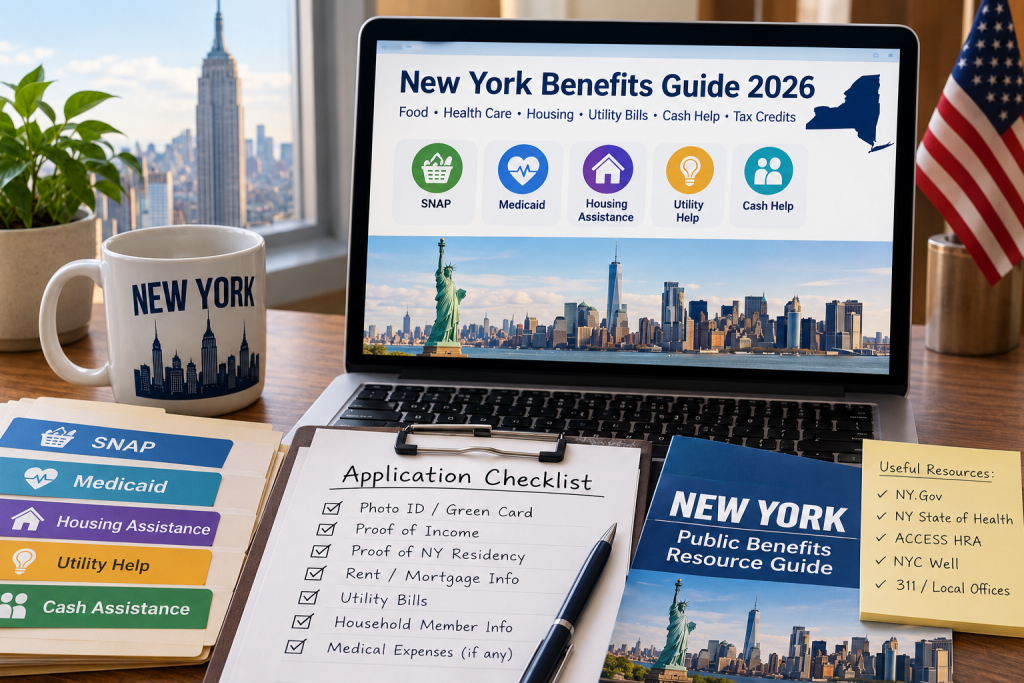
New York Benefits Guide Application Checklist Before You Start
Before applying for any New York benefit, gather your documents first. This can reduce delays and help you respond faster if an agency asks for proof.
- Photo ID
- Social Security numbers, if available
- Proof of New York address
- Recent pay stubs or income records
- Rent or mortgage documents
- Utility or heating bills
- Bank statements, if requested
- Medical bills, if relevant
- Child care expenses, if relevant
- School information for children, if relevant
- Immigration or qualified status documents, if applicable
- Letters or notices from benefit programs
- Application confirmation numbers
Common Reasons Applications Get Delayed or Denied
A delay or denial does not always mean the household has no options. Sometimes the problem is a missing document, a missed recertification, the wrong local office, or an outdated address.
- Income is above the program limit
- Household size was reported incorrectly
- Documents were missing or unreadable
- An interview, appointment, or verification request was missed
- The applicant used an outdated mailing address
- The application was submitted through the wrong agency or county office
- Program funding or waiting lists were closed
- A renewal or recertification deadline was missed
- The uploaded document did not match the request
- The applicant missed a weekly certification or follow-up step
Practical Tip
Keep a simple benefit folder. Save screenshots, confirmation numbers, upload receipts, letters, emails, and the date you submitted each application. If you call an office, write down the date, the phone number, and what they told you. This habit can help a lot if your case gets delayed or if you need to request a hearing.
Frequently Asked Questions
Can I apply for more than one New York benefit at the same time?
Yes. A household may check SNAP for food, Medicaid or CHIP information for health coverage, HEAP for heating help, Temporary Assistance for cash help, and housing resources for rent or voucher support. Each program has its own rules, so approval for one program does not guarantee approval for another.
Is SNAP the same as Temporary Assistance?
No. SNAP is food assistance. Temporary Assistance is cash help for eligible households and has separate rules. Some households may check both, but they are not the same program.
Where should I start for Medicaid or CHIP information?
Start with Healthcare.gov, USA.gov, or Medicaid.gov to understand Medicaid and CHIP basics. Then follow the New York-specific application path that matches your situation.
When should I check HEAP?
Check HEAP before the winter heating season becomes urgent. HEAP is seasonal, and funding or application periods can change. If you wait until a shutoff or fuel emergency is already close, the process can become more stressful.
Where can I find my local Department of Social Services?
Use the New York OTDA Local Departments of Social Services directory. Local DSS offices can matter for SNAP, Temporary Assistance, HEAP, and other local support.
What should I do if my application is denied?
Read the notice carefully. Look for the reason, the deadline, and any instructions for appeal or Fair Hearing. If the issue was missing documents, incorrect information, or a missed deadline, you may be able to submit updates, reapply, or request a hearing.
Why does this New York benefits guide include federal links too?
State links are usually the best starting point, but federal links from HUD, Healthcare.gov, Medicaid.gov, or USA.gov can help when someone needs a broader explanation or a backup official source.
Related Guides
- Florida Benefits Guide 2026
- Texas Benefits Guide 2026
- California Benefits Guide 2026
- State & Local Guides
Official New York and Federal Resources
- NY.gov Apply or Recertify for SNAP — Official New York SNAP application and recertification starting point.
- New York OTDA SNAP FAQ — SNAP questions and local office information.
- New York Local Departments of Social Services — County and local DSS office directory.
- Healthcare.gov Medicaid and CHIP — Federal guide to Medicaid and CHIP.
- USA.gov Medicaid and CHIP — Federal Medicaid and CHIP overview.
- Medicaid.gov New York State Profile — Federal Medicaid and CHIP state profile for New York.
- New York OTDA Temporary Assistance — Public Assistance and cash help information.
- Temporary Assistance FAQ — Official New York Temporary Assistance questions.
- NY.gov HEAP — Heating assistance information and application guidance.
- New York OTDA HEAP — Home Energy Assistance Program details.
- HEAP Contacts — Local HEAP office contact information.
- New York HCR Section 8 HCV — Section 8 Housing Choice Voucher information.
- New York MyHousing Portal — Section 8 and housing voucher portal.
- New York DOL Unemployment Claimant Benefit Process — Official unemployment claim guidance.
- New York DOL How Do I File? — Official filing steps for unemployment claims.
- Certify for Weekly Unemployment Insurance Benefits — Official weekly certification information.
- New York OTDA Request a Fair Hearing — Fair Hearing request information.
Disclaimer
FactBob is an independent informational website. We are not a government agency, and we do not process applications, decide eligibility, provide legal advice, or guarantee benefits. Program rules, funding, deadlines, documents, and eligibility requirements can change. Always confirm details with the official New York agency, federal resource, or local provider before applying.
Final Thoughts
This New York benefits guide is meant to help you avoid the most common mistake: starting in the wrong place. For food help, start with SNAP. For heating help, check HEAP early. For cash help, check Temporary Assistance. For housing help, check HCR, HUD, and local offices. For unemployment, go directly to the New York Department of Labor.
The biggest lesson from reading through these benefit pages is simple: the application is only one part of the process. The real difference often comes from preparing documents before you apply, using the correct official source, checking notices quickly, and keeping records of every upload, letter, and phone call.
If you are not sure where to begin, start with the program that matches your most urgent need. Then confirm the details on the official page before submitting anything.