
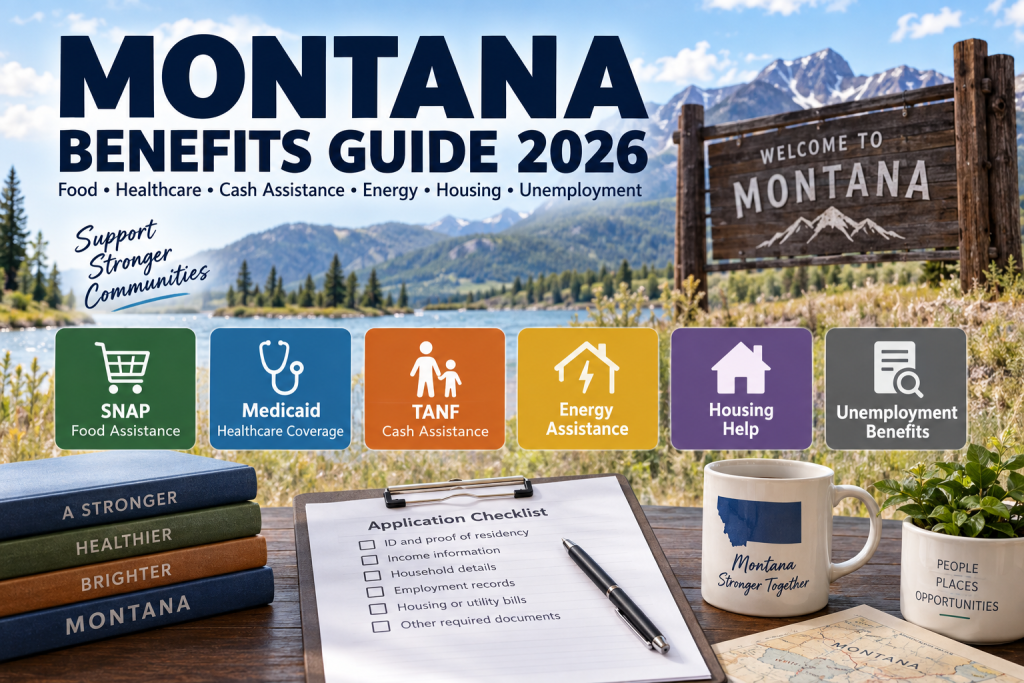
Last updated: September 7, 2026
Montana residents who are struggling with groceries, healthcare costs,
cash needs, winter heating bills, rent, or unemployment may be able to
use several state and federal assistance programs.
The main programs include SNAP for food assistance, Montana Medicaid
and Healthy Montana Kids for health coverage, TANF for temporary cash
assistance, LIHEAP for home energy costs, Housing Choice Vouchers for
rental assistance, and Montana Unemployment Insurance for eligible workers.
Montana also has several important 2026 changes that applicants should
know about. In particular, new community engagement requirements took
effect for many adults enrolled through Medicaid Expansion on July 1, 2026,
and Montana has already published new 2026–2027 energy assistance limits.
This Montana benefits guide explains where to start, what documents may
be required, important current rules, and where to verify information
through official Montana government resources.
Quick Answer:
For SNAP, Medicaid, and TANF, Montana’s Department of Public Health
and Human Services is usually the main starting point.
The state directs online applicants to
apply.mt.gov
.
Energy assistance is administered through Montana DPHHS and local
eligibility or Tribal LIHEAP offices.
Housing Choice Vouchers are administered through Montana Housing
and regional field agencies.
Unemployment claims are handled separately by the Montana Department
of Labor & Industry.
Important:
FactBob is an independent informational website and is not affiliated
with the State of Montana, DPHHS, Montana Housing, the Department of Labor
& Industry, HUD, or any federal, Tribal, county, or local government agency.
Eligibility rules, income limits, work requirements, waiting lists,
benefit amounts, application periods, and program funding can change.
Always verify important information directly with the agency
responsible for the program.
Montana Benefits Quick Overview
| Program | What It May Help With | Main Agency |
|---|---|---|
| SNAP | Food and groceries | Montana DPHHS |
| Montana Medicaid | Healthcare coverage | Montana DPHHS |
| Healthy Montana Kids | Health coverage for eligible children | Montana DPHHS |
| TANF | Temporary cash assistance for qualifying families | Montana DPHHS |
| LIHEAP | Winter heating and energy costs | Montana DPHHS / Local Agencies |
| Housing Choice Voucher | Rental assistance | Montana Housing |
| Unemployment Insurance | Temporary income after qualifying job loss | Montana Department of Labor & Industry |
What I Would Do Before Applying
If I were applying for assistance in Montana today, I would first identify
all of the programs that might apply to my household rather than looking
at only one benefit.
For example, someone who recently lost a job may want to check SNAP,
Medicaid, LIHEAP, housing assistance, and unemployment benefits at the
same time.
I would gather recent income records, household information, rent or
mortgage information, utility bills, identification documents, and
employment records before starting.
I would also keep copies of every confirmation page, notice, document,
and deadline. In real life, many benefit problems happen after the
application is submitted because an interview, verification request,
renewal, or weekly unemployment filing is missed.
1. Montana’s Online Benefits Application
Montana DPHHS currently directs applicants for programs such as SNAP,
Medicaid, and TANF to the state’s online application system at:
Montana Online Benefits Application
The state also provides other ways to apply or get help, including the
DPHHS Public Assistance Helpline at 1-888-706-1535
and local Offices of Public Assistance.
Because the application portal itself may require login or block some
automated systems, applicants should use DPHHS program pages as the
official starting point and follow the application links provided there.
Documents You May Want Ready
- Names and birth dates of household members
- Current address
- Social Security information when required
- Citizenship or immigration information when applicable
- Recent wages and other income
- Employer information
- Rent or mortgage expenses
- Utility costs
- Childcare expenses when applicable
- Health insurance information
2. Montana SNAP Food Assistance
The Supplemental Nutrition Assistance Program, or SNAP, helps eligible
Montana households purchase food.
Montana DPHHS determines SNAP eligibility based on household composition,
income, resources when applicable, and other program rules.
Official information:
Montana SNAP Program
.
How to Apply for Montana SNAP
Montana currently provides several application options:
- Apply online at apply.mt.gov
- Call the Public Assistance Helpline at 1-888-706-1535
- Visit a local Office of Public Assistance
- Use a paper application when appropriate
SNAP Income Standards: October 1, 2026 through September 30, 2027
Montana’s dated SNAP income standards manual lists the following monthly limits for the 2026–2027 period.
| Household size | Expanded Categorical Eligibility gross monthly limit | Net monthly limit when a net-income test applies |
|---|---|---|
| 1 | $2,660 | $1,330 |
| 2 | $3,608 | $1,804 |
| 3 | $4,554 | $2,277 |
| 4 | $5,500 | $2,750 |
Different tests and exceptions apply by household category. The state manual exempts categorically eligible and expanded categorically eligible households from the net-income test; other households may face both gross and net tests. These columns are not two tests that every household must pass. Check the manual and DPHHS instructions for the category that applies to you.
Expedited SNAP
Some households with very low income and limited liquid resources
may qualify for expedited SNAP.
Montana DPHHS states that qualifying expedited households may receive
food benefits within seven calendar days of the application date.
Examples can include certain households with less than $150 in monthly
gross income and $100 or less in liquid resources, although other eligibility
rules apply.
SNAP Work Rules
Montana states that able-bodied household members ages 16 through 59
generally must register for work unless they qualify for an exemption.
Some participants may also be required to participate in SNAP Employment
and Training.
Current Montana SNAP Work-Rule Note:
Recent federal changes removed some previous ABAWD exemptions
and ended Montana’s geographic ABAWD waiver.
Beginning October 1, 2025, former exemptions for certain veterans,
people experiencing homelessness, and some former foster youth were removed.
Montana’s geographic ABAWD waiver was then canceled effective
November 1, 2025.
Because SNAP work rules and exemptions have changed recently,
do not rely on older Montana SNAP articles when deciding whether
a work requirement applies to you.
SNAP Application Checklist
- Household information
- Income and wage records
- Rent or mortgage costs
- Utility expenses
- Childcare costs when applicable
- Medical expenses when applicable
- Identification or residency information when requested
- Documents requested by DPHHS after application
3. Montana Medicaid and Medicaid Expansion
Montana Medicaid provides healthcare coverage to eligible residents
through several eligibility categories.
Programs may serve children, adults, pregnant individuals,
older residents, and people with disabilities depending on their
income and other circumstances.
Montana Medicaid applications can be started through:
apply.mt.gov
.
Major 2026 Montana Medicaid Change:
Beginning July 1, 2026, Montana implemented new
community engagement requirements for many adults in the state’s
Medicaid Expansion population.
Adults ages 19 through 64 enrolled through Medicaid
Expansion generally must complete at least
80 hours per month of qualifying activities unless
they meet an exclusion.
Qualifying activities can include:
- Working
- Approved community service or nonprofit volunteering
- Approved workforce training or job-readiness programs
- School
- A combination of qualifying activities
Montana DPHHS requires eligible members to verify that the requirement
is being met.
At a new application, DPHHS may review the month before the application.
At redetermination, members may need to show qualifying activity during
at least three months since the prior redetermination.
Read Montana’s current explanation here:
2026 Montana Medicaid Changes
.
Who May Be Excluded From the 80-Hour Requirement?
The requirement does not apply in the same way to everyone.
Montana lists several possible exclusions or exceptions.
Examples include certain:
- American Indian or Alaska Native individuals
- Former foster youth under specified conditions
- People with medical conditions affecting their ability to participate
- Parents or caregivers of a dependent child under age 14
- Caregivers of a disabled individual
- People participating in qualifying substance-use treatment
- People who meet specified TANF or SNAP work requirements
- Pregnant and certain postpartum individuals
- Certain veterans with a total disability rating
The actual exclusion decision depends on the person’s circumstances
and DPHHS verification.
Medicaid Tip:
If you receive Montana Medicaid Expansion coverage, keep your address,
phone number, income information, employment status, and education status current.
The state specifically warns members to read notices carefully and respond
to verification requests so coverage is not interrupted.
Marketplace Change Effective October 1, 2026
Beginning October 1, 2026, people applying for Montana
Medicaid Expansion through the federal Health Insurance Marketplace may
also be subject to Montana’s community engagement requirement.
The federal Marketplace does not make the final community-engagement
determination. Montana DPHHS reviews the case and determines whether the
requirement or an exclusion is satisfied.
Montana Medicaid Application Checklist
- Household members
- Birth dates
- Current income
- Employer information
- Other health insurance
- Citizenship or immigration information when required
- Community engagement records if applicable
- School, work, training, or volunteer records when applicable
- Documents supporting an exclusion when required
4. Healthy Montana Kids (HMK)
Healthy Montana Kids is Montana’s Children’s Health Insurance Program,
or CHIP.
It provides free or low-cost health insurance coverage to eligible
Montana children up to age 19.
Coverage may include medical services, dental care, eyeglasses,
pharmacy benefits, and other medically necessary services.
Official information:
Healthy Montana Kids
.
2026 HMK Update:
Montana adopted an updated Healthy Montana Kids Evidence of Coverage
during 2026.
The state’s 2026 rule update included changes such as adding certain
pre-release services for eligible incarcerated youth and updating
program information and service links.
Parents should use the current HMK member information rather than
an older benefit booklet when checking covered services.
Healthy Montana Kids Checklist
- Child’s name and birth date
- Household information
- Household income
- Current health coverage information
- Residency information
- Citizenship or immigration documentation when required
5. Montana TANF Cash Assistance
Montana’s Temporary Assistance for Needy Families program provides
temporary financial assistance to certain qualifying families.
Montana DPHHS states that TANF cash assistance is generally limited
to 60 months during an adult’s lifetime.
Potentially qualifying households can include minor children and
specified relatives caring for those children, as well as certain
pregnant women and qualifying refugee families.
Official Montana TANF information:
Montana TANF
.
How to Apply for TANF
Montana currently directs applicants to:
- Apply online at apply.mt.gov
- Call 1-888-706-1535
- Visit a local Office of Public Assistance
- Use an available paper application
Important TANF Amount Note:
The Montana DPHHS TANF webpage currently displays income and payment
standards that show an effective date of July 1, 2023.
Because the page remains online in 2026 but the underlying table has
an older effective date, applicants should verify the amount DPHHS
will use for their current application instead of treating an older
payment-standard table as a guaranteed 2026 benefit amount.
TANF Application Checklist
- Children and household member information
- Income records
- Employment information
- Housing expenses
- Childcare needs
- Identification information
- Documents requested by DPHHS
- Work-program information when applicable
6. Montana LIHEAP Energy Assistance
Montana’s Low Income Home Energy Assistance Program,
commonly called LIHEAP, helps eligible households with a portion
of winter home energy costs.
The state also administers the Weatherization Assistance Program,
which can help qualifying households improve home energy efficiency.
Both renters and homeowners may apply if they meet program requirements.
Official information:
Montana LIHEAP and Weatherization
.
2026–2027 Montana LIHEAP Update:
Montana has already published income and resource limits for the
2026–2027 program year.
The current LIHEAP upper-income limits include:
- 1 person: $36,120 annually
- 2 people: $47,234 annually
- 3 people: $58,348 annually
- 4 people: $69,463 annually
The corresponding upper resource limits begin at:
- 1 person: $14,717
- 2 people: $22,515
- 3 people: $24,017
- 4 people: $25,518
Different limits apply to larger households.
When Can You Apply?
Montana’s standard LIHEAP heating season generally runs from
October 1 through April 30.
Weatherization assistance may be requested throughout the year.
Montana also advises people needing assistance to contact the local
eligibility or Tribal LIHEAP office serving their community.
Households that receive SNAP, Supplemental Security Income,
or TANF may also qualify for LIHEAP under current Montana rules,
although the agency still determines program eligibility.
Current Heating Season:
The 2026–2027 LIHEAP heating season is open. Applications are accepted
October 1 through April 30. Contact the local eligibility or Tribal LIHEAP
office, gather energy bills and income records, and use the current
2026–2027 limits above.
LIHEAP Checklist
- Household member information
- Recent income records
- Heating bill
- Electric bill
- Utility account information
- Home heating fuel information
- Resource information when required
- Any shutoff or emergency notice
7. Montana Housing Choice Voucher and Rental Assistance
Montana Housing administers Housing Choice Vouchers and other rental
assistance programs in communities throughout the state.
The Housing Choice Voucher program is commonly known as Section 8.
Eligible households generally pay a portion of adjusted household
income toward rent, with the program paying qualifying rental assistance
subject to program rules.
Official information:
Montana Housing Choice Voucher Program
.
September 2026 Montana Housing Update:
Montana Housing currently reports that both the
Housing Choice Voucher and Moderate Rehabilitation waiting lists are open.
Applicants can select the appropriate Housing Choice Voucher region
and submit an application for one of Montana’s regional waiting lists.
Montana Housing currently lists 10 Housing Choice Voucher regions.
The agency also has 2026 voucher payment standards effective
July 1, 2026.
2026 Montana Residency Preference
Montana’s 2026 Housing Choice Voucher annual plan states that the
Department of Commerce is implementing a waiting-list preference
for residents of the State of Montana.
The plan states that this residency preference does not apply to the
Mainstream Program.
A preference does not guarantee that an applicant will quickly receive
a voucher. Waiting time depends on factors such as the selected region,
preference status, application date, funding, and available vouchers.
Housing Application Checklist
- Household members
- Current contact information
- Income information
- Household composition
- Current housing information
- Documentation supporting a program preference when applicable
- Updated mailing address while waiting
Housing Tip:
Once you are on a housing waiting list, keep your contact information updated.
Montana Housing specifically provides a process for applicants to report
changes while on the waiting list. Missing correspondence after moving
can cause serious problems with a housing application.
8. Montana Unemployment Insurance
Montana Unemployment Insurance provides temporary income to qualifying
workers who are unemployed through no fault of their own and who meet
the state’s continuing eligibility requirements.
The program is administered by the Montana Department of Labor &
Industry’s Unemployment Insurance Division.
Official unemployment page:
Montana Unemployment Insurance Division
.
Claimant information:
Montana UI Claimant Resources
.
2026 Montana Work Search Requirement:
Most unemployment recipients who are required to search for work
must make an active, good-faith effort to find employment.
Montana currently requires at least
one qualifying work-search contact each week.
The contact must involve actually applying for work, such as completing
an application or submitting a resume to an employer with hiring authority.
Simply reading job advertisements does not count as a work-search contact.
The same employer generally cannot be used for two consecutive weeks
unless the employer specifically requested another contact.
Current rules:
Montana Work Search Requirements
.
You Must Request Payment Every Week
Submitting an initial unemployment claim is not enough to continue
receiving benefits.
Montana requires claimants to submit a
weekly payment request for every week for which they
want benefits.
The state’s UI Claimant Center is used for initial claims,
reactivating claims, and filing weekly payment requests.
Report Work and Earnings Correctly
Montana defines an unemployment week as beginning Sunday and ending Saturday.
If you work during a week for which you request benefits,
keep records of all hours and report gross earnings as required,
even if the employer has not paid you yet.
Information Needed to File
Montana says claimants should be prepared to provide employment information
for approximately the previous 18 months, including employer names,
addresses, phone numbers, and dates of employment.
Depending on the claimant, additional information may include:
- Bank routing and account information for direct deposit
- Union information
- DD214 for qualifying former military members
- Federal employment documents such as SF-8 or SF-50
- Alien registration information for applicable non-U.S. citizens
9. Additional Food Help: Montana TEFAP
Montana also participates in The Emergency Food Assistance Program,
or TEFAP.
TEFAP distributes USDA foods through participating local organizations
to eligible households.
2026 Montana TEFAP Update:
Montana’s 2026 TEFAP income guideline is set at
300% of the federal poverty guideline.
For example, the current monthly limit is:
- 1 person: $3,990
- 2 people: $5,410
- 3 people: $6,830
- 4 people: $8,250
Montana residency is required, but the state’s current guidance says
households are not required to provide an address or identification
solely to demonstrate residency for TEFAP.
Official information:
Montana TEFAP
.
Common Reasons Montana Benefit Applications Can Be Delayed
- Missing requested verification documents
- Incomplete household information
- Using outdated income figures
- Missing a SNAP interview or agency request
- Not responding to Medicaid community-engagement verification
- Missing Medicaid renewal or redetermination notices
- Failing to update a housing waiting-list address
- Applying for LIHEAP without required income or energy information
- Failing to make an unemployment work-search contact
- Failing to submit the weekly unemployment payment request
- Incorrectly reporting hours or earnings while receiving unemployment
Complete Montana Benefits Application Checklist
Not every benefit program requires every document below,
but organizing these records before applying can make the process easier.
- Photo identification when required
- Social Security information when required
- Birth dates for household members
- Current address
- Recent pay stubs
- Employer information
- Unemployment or Social Security income
- Other household income
- Bank or resource information when required
- Rent or mortgage records
- Utility bills
- Childcare expenses
- Medical expenses when relevant
- Current health insurance information
- Community engagement records for affected Medicaid members
- Housing waiting-list correspondence
- Unemployment work-search records
Practical Tip: Keep a Benefit Paper Trail
One of the easiest ways to reduce confusion is to keep a separate
folder for government benefit applications.
Save:
- The date you applied
- Confirmation numbers
- Documents submitted
- Agency letters
- Important phone calls
- Names of agency representatives when available
- Interview dates
- Renewal dates
- Housing waiting-list information
- Medicaid community-engagement records
- Unemployment weekly payment confirmations
- Unemployment work-search records
If an application is delayed or benefits stop unexpectedly,
this record can make it much easier to identify what happened.
Frequently Asked Questions
Where do I apply for SNAP in Montana?
Montana DPHHS currently allows SNAP applications online through
apply.mt.gov, by phone through the Public Assistance Helpline,
or through a local Office of Public Assistance.
Can Montana SNAP be expedited?
Yes. Certain households with very low income and limited liquid
resources may qualify for expedited processing, which Montana says
can make SNAP available within seven calendar days.
Did Montana Medicaid rules change in 2026?
Yes. Beginning July 1, 2026, many adults ages 19 through 64 in the
Medicaid Expansion population must complete 80 hours per month of
qualifying community engagement activities unless an exclusion applies.
Does the Medicaid 80-hour rule apply to every Montana Medicaid member?
No. The rule primarily affects Medicaid Expansion adults,
and multiple exclusions and exceptions exist.
DPHHS determines whether an individual must meet the requirement.
What is Healthy Montana Kids?
Healthy Montana Kids is Montana’s Children’s Health Insurance Program.
It provides free or low-cost coverage for qualifying children under age 19.
How long can an adult receive Montana TANF?
Montana DPHHS states that receipt of TANF cash assistance is generally
limited to 60 months during an adult’s lifetime.
Other eligibility rules also apply.
When does Montana LIHEAP open?
The standard Montana LIHEAP heating season generally runs from
October 1 through April 30.
Weatherization assistance can be requested throughout the year.
Is the Montana Section 8 waiting list open?
Montana Housing currently states that its Housing Choice Voucher
and MOD Rehab waiting lists are open.
Applicants should select the correct regional waiting list and verify
the current status before applying.
How many job searches do I need for Montana unemployment?
Montana currently generally requires at least one qualifying
employer work-search contact each week for claimants who are subject
to the work-search requirement.
Do I need to file for unemployment every week?
Yes. Montana requires a weekly payment request for each week
for which you want unemployment benefits.
Related State Guides
-
Wisconsin Benefits Guide 2026
-
Washington Benefits Guide 2026
-
Arizona Benefits Guide 2026
-
Missouri Benefits Guide 2026
-
Browse All State Benefit Guides
Official Montana Resources
-
Montana Online Benefits Application:
apply.mt.gov
-
Montana SNAP:
Montana DPHHS SNAP
-
Montana TANF:
Montana DPHHS TANF
-
2026 Medicaid Changes:
Montana DPHHS Medicaid Changes
-
Healthy Montana Kids:
Healthy Montana Kids
-
Montana Energy Assistance:
Montana LIHEAP and Weatherization
-
Montana Housing Choice Voucher:
Montana Housing
-
Montana Unemployment Insurance:
Montana Unemployment Insurance Division
-
Montana Unemployment Claimant Resources:
Montana UI Claimant Resources
-
Montana Work Search Requirements:
Work Search Requirements
-
Montana TEFAP:
Emergency Food Assistance Program
Disclaimer
This Montana benefits guide is provided for general informational purposes only.
FactBob is not a government agency and does not determine eligibility,
process applications, issue benefits, manage housing waiting lists,
or provide legal, medical, financial, or tax advice.
Program requirements, income limits, work requirements, benefit amounts,
application periods, housing waiting lists, and funding can change.
Always verify important information directly with the appropriate
Montana or federal agency.
Final Thoughts
Montana residents have several different places to turn for assistance,
and the best starting point depends on the kind of help needed.
For food assistance, Medicaid, and TANF, Montana DPHHS is usually the
main agency to check. For winter energy costs, contact the LIHEAP office
serving your area. Renters can review Montana Housing’s currently open
Housing Choice Voucher waiting lists, while workers who have lost employment
should use the Montana Unemployment Insurance system.
The biggest 2026 issue to pay attention to is Montana Medicaid Expansion’s
new community engagement requirement. A person who assumes the rules are the
same as they were in early 2026 could miss an important verification requirement.
Finally, keep in mind that several Montana program figures change on
different schedules. The SNAP income table shown above applies from October 1, 2026,
through September 30, 2027; LIHEAP heating applications run October 1 through
April 30. Always check the effective date
before relying on an income limit or benefit rule.

