Last updated: July 17, 2026
This North Carolina benefits guide is for people who need a clear starting point for food assistance, health coverage, utility bill help, cash assistance, housing resources, and unemployment benefits in North Carolina.
North Carolina benefits can feel confusing because several programs use different names and different offices. SNAP is often called Food and Nutrition Services, or FNS, in North Carolina. Medicaid is handled through NC Medicaid and local Department of Social Services offices. Energy assistance includes LIEAP and the Crisis Intervention Program. Cash help may involve Work First Family Assistance. Housing resources may involve the North Carolina Housing Finance Agency, HUD, or local public housing agencies. Unemployment benefits are handled by the North Carolina Division of Employment Security.
The part that usually causes stress is not always the first application. It is what happens after: a pay stub is missing, a utility bill does not show the account information, an address is outdated, a DSS notice is opened too late, or a weekly unemployment certification is missed.
If I were preparing a North Carolina benefits application today, I would not start by clicking every program link at once. I would first make one folder for identification, income records, rent or mortgage documents, utility bills, medical expenses, household information, screenshots, confirmation numbers, and notices from agencies. That small step can make the rest of the process much easier.

North Carolina Benefits Guide: Quick Answer
If you live in North Carolina and need help with food, medical coverage, utility bills, cash assistance, housing, or unemployment, start with the official North Carolina or federal resource that matches your situation.
For food assistance, start with NCDHHS Apply for Food and Nutrition Services or ePASS.
For Medicaid, use NC Medicaid How to Apply. For energy help, check NCDHHS LIEAP and the Crisis Intervention Program. For cash assistance, check Work First Family Assistance. For unemployment, use NC Division of Employment Security Apply for Unemployment.
Important: This North Carolina benefits guide does not determine eligibility or process applications. Income limits, documents, program rules, funding, application periods, waiting lists, weekly certification rules, and deadlines can change. Always confirm current information with the official North Carolina agency, federal agency, local DSS office, local housing authority, or authorized program administrator before applying.
Quick Overview of North Carolina Benefit Programs
| Need | Program or Resource | Where to Start |
|---|---|---|
| Food assistance | Food and Nutrition Services / SNAP | NCDHHS / ePASS / Local DSS |
| Health coverage | NC Medicaid | NC Medicaid / ePASS / Local DSS |
| Utility bills | LIEAP and Crisis Intervention Program | NCDHHS Energy Assistance / Local DSS |
| Cash help | Work First Family Assistance | NCDHHS / Local DSS |
| Housing | Rental assistance resources, public housing, Housing Choice Vouchers | NCHFA / HUD / Local PHA |
| Job loss | Unemployment Insurance | NC Division of Employment Security |
What I Would Do Before Applying
If I were starting a North Carolina benefits application today, I would do these things before filling out the form:
- Check that my mailing address, phone number, and email are current.
- Gather recent pay stubs and other income records.
- Write down the names and birth dates of everyone in the household.
- Save rent, mortgage, utility, medical, and child care expense records.
- Take clear photos or scans of documents that may need to be uploaded.
- Create one folder for confirmation numbers, screenshots, letters, and notices.
- Find the correct local DSS office for county-based programs.
It sounds simple, but many application problems are easier to handle when you can quickly prove what you submitted and when you submitted it.
1. Food and Nutrition Services, or SNAP, in North Carolina
North Carolina’s SNAP program is commonly called Food and Nutrition Services, or FNS. It helps eligible households buy food when money is tight.
The official North Carolina page says people can apply online with ePASS or apply in person at a Department of Social Services office. If applying in person, the state recommends filling out as much of the paper application as possible ahead of time and bringing documents with you.
The part I would be most careful with is household information. A recent move, a job change, a different rent amount, a new child care cost, or a household member moving in or out can change what needs to be reported.
A common mistake is starting the application without the exact numbers nearby. Guessing at income, rent, or utility costs can lead to mismatched information and more questions later.
FNS/SNAP checklist before applying
- Full names and dates of birth for household members
- Current North Carolina address
- Recent pay stubs or other income records
- Rent or mortgage information
- Utility expenses
- Social Security numbers for applicants who have them
- Child care expenses, if relevant
- Medical expenses for elderly or disabled household members, if relevant
Common FNS/SNAP problems to watch for
- Household size is reported incorrectly
- Income information is old or incomplete
- Rent or utility information does not match current circumstances
- Requested documents are not returned
- An interview or verification request is missed
- The mailing address or phone number is outdated
- The applicant forgets to complete recertification on time
North Carolina also allows online FNS/SNAP recertifications and change of circumstance submissions through ePASS. That can help, but only if you actually check notices and submit updates before the deadline.
Official starting points:
- NCDHHS Apply for Food and Nutrition Services
- NCDHHS Food and Nutrition Services
- ePASS North Carolina
- North Carolina Local DSS Directory
- USA.gov SNAP Information
2. NC Medicaid
NC Medicaid provides health coverage for eligible North Carolina residents. The official NC Medicaid application page says people can apply online through ePASS, where Medicaid is called “Medical Assistance” on the application.
If I were applying online, I would save the confirmation information right away. It is easy to assume you can find it later, but if the application takes longer than expected, having that record can make follow-up easier.
Another practical issue is mail. If North Carolina needs more information, a notice may be sent. Missing that notice or returning documents after the deadline can create a denial even when the household may otherwise have qualified.
NC Medicaid also encourages beneficiaries to use enhanced ePASS accounts to view case details, renew Medicaid, and update information without visiting or calling the local DSS office.
Medicaid checklist before applying
- An address where you can reliably receive mail
- Full names and dates of birth for household members
- Social Security numbers for applicants who have them
- Immigration or registration information when applicable
- Household income information
- Current health insurance information, if any
- Pregnancy information, if applicable
- Disability or medical information, if applicable
- Financial resource information when required for a particular Medicaid category
Common Medicaid problems to watch for
- A document request is missed
- The requested documents are returned after the deadline
- The mailing address is outdated
- Household income information is incomplete
- A renewal or recertification notice is ignored
- The applicant does not save confirmation or case information
Official starting points:
- NC Medicaid How to Apply
- NC Medicaid Beneficiaries
- NC Medicaid Recertification
- ePASS North Carolina
- Healthcare.gov Medicaid and CHIP
- USA.gov Medicaid and CHIP
3. LIEAP and Crisis Utility Help in North Carolina
The Low Income Energy Assistance Program, or LIEAP, is a federally funded program that provides a one-time vendor payment to help eligible households pay heating bills.
North Carolina’s official LIEAP page says households with a person age 60 or older or disabled persons receiving services through the NC Division of Aging and Adult Services may sign up from December 1 through December 31. All other households may apply from January 1 through March 31, or until funds are exhausted.
This is a program where timing matters. If I needed heating help, I would check the official page before the coldest part of the season, not after the bill becomes urgent.
North Carolina also has the Crisis Intervention Program, or CIP, for households experiencing or in danger of experiencing a heating or cooling-related crisis.
If a utility situation is urgent, I would contact the local DSS office or program contact as soon as possible rather than waiting for the final shutoff date.
LIEAP and CIP checklist before applying
- Current heating, electric, or utility bill
- Utility account information
- Proof of household income
- Proof of North Carolina residence
- Household member information
- Proof of age or disability status when relevant
- Shutoff notice or crisis information, if applicable
- Proof that you are responsible for the energy cost
Common energy assistance problems to watch for
- The LIEAP application period is not open yet
- Funds are exhausted before the listed end date
- The household contacts the wrong local DSS office
- Income documentation is incomplete
- The utility account information is missing
- A crisis situation is handled too late
Official starting points:
- NCDHHS Energy Assistance
- NCDHHS Low Income Energy Assistance LIEAP
- NCDHHS Crisis Intervention Program
- North Carolina Local DSS Directory
- USA.gov Help With Utility Bills
4. Work First Cash Assistance in North Carolina
Work First Family Assistance is North Carolina’s cash assistance program for eligible families. NCDHHS explains that Work First aims to shorten the length of time families receive assistance by making work mandatory and limiting how long a family can receive cash assistance.
Cash assistance is different from SNAP. SNAP helps with food. Work First cash assistance has different rules, documents, work-related expectations, and follow-up steps.
One thing I would pay close attention to is the Mutual Responsibility Agreement, sometimes called an MRA or Outcome Plan. NCDHHS says parents must sign an MRA/Outcome Plan to receive Work First Family Assistance.
A practical mistake is assuming that the application is finished after the first form. Depending on the household situation, the local DSS office may need more information, an appointment, work-related documentation, or child support-related cooperation.
Work First checklist before applying
- Proof of identity
- Current North Carolina address
- Household member information
- Income records
- Information about children in the household
- Rent and household expense information
- Employment or work activity information, if requested
- Social Security numbers for applicants who have them
Common reasons Work First may be delayed or denied
- Income or resources do not meet program requirements
- Household information is incomplete
- Documents are missing or unreadable
- A required appointment or interview is missed
- Work-related requirements are not completed
- The applicant does not respond to a DSS notice
- The MRA or Outcome Plan requirements are not followed
Official starting points:
- Work First Family Assistance
- About Work First
- Work First Eligibility and Income Requirements
- Work First Emergency Assistance
- North Carolina Local DSS Directory
- USA.gov TANF and Welfare Benefits
5. Housing Assistance and Rental Resources in North Carolina
Housing assistance in North Carolina can involve the North Carolina Housing Finance Agency, HUD, local public housing agencies, local housing authorities, and community organizations.
The North Carolina Housing Finance Agency explains that if you need rental assistance because of income, you can apply for a Housing Choice Voucher at your local Public Housing Authority.
If I were looking for housing help, I would first separate the situation into one of three categories: finding affordable rental housing, applying for a Housing Choice Voucher or public housing, or dealing with an urgent eviction or homelessness situation.
Those are different problems, and they may use different offices. A household looking for a voucher may need a local public housing authority. A household facing eviction may need emergency assistance, legal help, a community agency, or county-level support.
Housing checklist before contacting a program
- Photo ID
- Household member information
- Proof of income
- Current lease or rental agreement
- Current monthly rent
- Past-due rent notice, if any
- Eviction or court paperwork, if any
- Disability, senior, or veteran information when relevant to a specific program
Common housing assistance problems
- A Housing Choice Voucher waiting list is closed
- The applicant contacts the wrong local housing authority
- The household is outside a program’s service area
- The applicant misses a waiting list update notice
- Household or income documents are incomplete
- The applicant relies on an old rental assistance program that is no longer accepting applications
- A scammer asks for money to move the applicant ahead on a waiting list
Official starting points:
- NCHFA Need Assistance Paying Rent?
- NCHFA Renters Resources
- HUD North Carolina
- HUD Public Housing Agency Contacts
- USA.gov Rental Housing Programs
6. Unemployment Benefits in North Carolina
North Carolina unemployment insurance provides temporary payments to eligible workers who lose their jobs through no fault of their own. The North Carolina Division of Employment Security says people can apply online or by phone.
One of the easiest mistakes to make is thinking that filing the first unemployment claim is the whole process. It is not.
North Carolina requires weekly certifications. The official DES page says you must file a weekly certification within 14 days after each week, Sunday through Saturday, or you will not get paid for that week.
If I had just filed a North Carolina unemployment claim, I would immediately save the claim information and put a weekly reminder into my phone calendar. Missing a weekly certification is exactly the kind of small mistake that can create unnecessary stress.
Unemployment checklist before filing
- Social Security number
- Recent employer name and address
- Dates worked
- Reason employment ended
- Wage information
- Current mailing address
- Current phone number
- Information about work performed while claiming benefits
- Work search records when required
Common unemployment problems to watch for
- Employer information is incomplete
- The reason for separation is unclear
- A request from DES is ignored
- The claimant forgets weekly certifications
- Wages or part-time work are not reported correctly
- Required work search activities are not completed or recorded
Official starting points:
- Apply for Unemployment in North Carolina
- Filing Your Unemployment Application
- NC DES Weekly Requirements
- File Your Weekly Certification
- USA.gov Unemployment Benefits
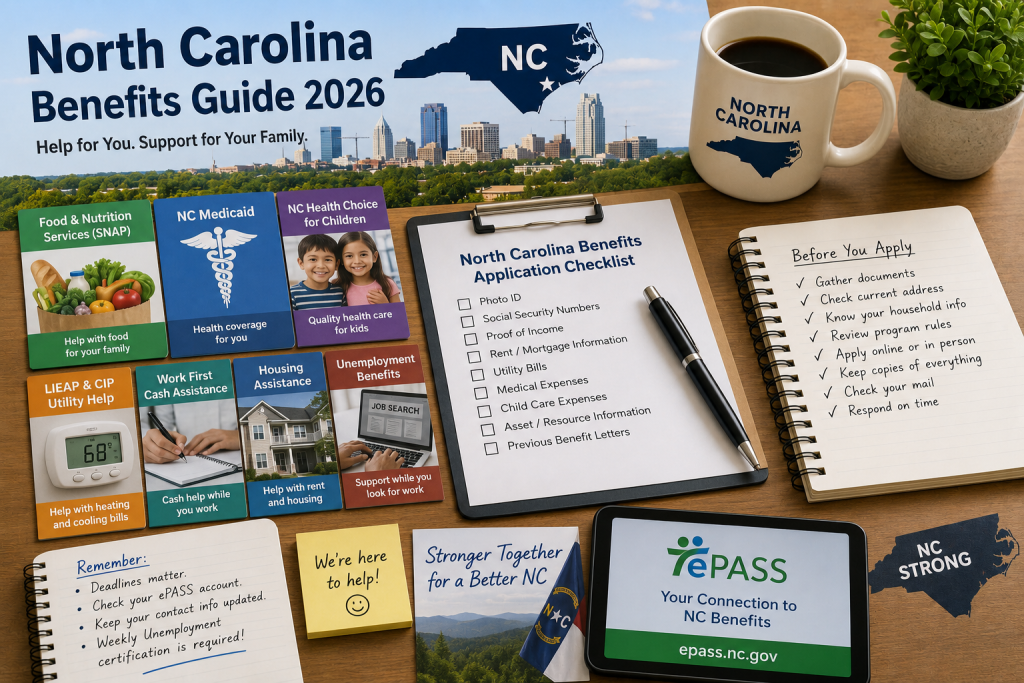
North Carolina Benefits Guide Application Checklist
You will not need every document for every program, but gathering the basics before applying can make the process much easier.
- Photo ID or other identification
- An address where you can reliably receive mail
- Names and dates of birth for household members
- Social Security numbers for applicants who have them
- Recent pay stubs or other income records
- Rent or mortgage documents
- Utility bills
- Health insurance information
- Bank or resource information when required by the specific program
- Medical expenses, if relevant
- Child care expenses, if relevant
- Immigration documents when applicable and requested
- Previous benefit notices
- Application confirmation, tracking, or case numbers
Common Reasons North Carolina Benefit Applications Get Delayed or Denied
A delay or denial does not always mean there is nothing else you can do. Sometimes the problem is a missing document, an incorrect household detail, a missed deadline, or an application sent to the wrong place.
- Income does not meet the program requirements
- Household information is incomplete or incorrect
- Documents are missing
- Uploaded documents are blurry or unreadable
- A verification request is missed
- An interview or appointment is missed
- The mailing address or phone number is outdated
- A renewal or recertification deadline is missed
- A housing waiting list is closed
- LIEAP season is closed or funds are exhausted
- An unemployment weekly certification is missed
Practical Tip: Keep a Benefit Paper Trail
If I had to choose one habit that makes benefit applications easier to manage, it would be keeping a paper trail.
Save screenshots of confirmation pages. Keep tracking numbers. Take a photo of documents before mailing them. Save copies of everything you upload.
If you call an office, write down the date, the phone number, and what you were told. If a notice has a deadline, put the deadline in your phone calendar immediately.
When everything goes smoothly, this may feel unnecessary. When a document is missing, a case is delayed, or a notice is questioned, those records become extremely useful.
Frequently Asked Questions
Is North Carolina SNAP the same as Food and Nutrition Services?
Yes. North Carolina commonly refers to SNAP as Food and Nutrition Services, or FNS. The program helps eligible households buy food.
Where do I apply for North Carolina food assistance?
You can apply online through ePASS or apply in person at your local Department of Social Services office. Check the official NCDHHS Food and Nutrition Services page for current instructions.
Can I apply for NC Medicaid online?
Yes. NC Medicaid says people can apply online through ePASS. On the application, NC Medicaid is referred to as “Medical Assistance.”
When can I apply for North Carolina LIEAP?
NCDHHS says households with a person age 60 or older or disabled persons receiving services through the NC Division of Aging and Adult Services may sign up from December 1 through December 31. All other households may apply from January 1 through March 31, or until funds are exhausted.
What is the Crisis Intervention Program in North Carolina?
The Crisis Intervention Program helps individuals and families experiencing or in danger of experiencing a heating or cooling-related crisis. Applications can be handled through local DSS processes.
Where do I apply for Section 8 in North Carolina?
Housing Choice Voucher and public housing applications are usually handled by local public housing agencies. Use HUD Public Housing Agency Contacts or North Carolina housing resources to find the correct office and check waiting list status.
How often do I file unemployment certifications in North Carolina?
North Carolina DES says weekly certifications must be filed every week, and you must file within 14 days after each week or you will not get paid for that week.
What should I do if my benefit application is denied?
Read the notice carefully. Look for the specific reason, deadline, and instructions for submitting missing information, requesting a review, filing an appeal, or applying again. Keep the notice and copies of everything you previously submitted.
Why does this North Carolina benefits guide include federal links?
North Carolina agency pages are usually the best starting point for North Carolina applications. Federal resources from USA.gov, HUD, and Healthcare.gov can provide additional explanations and help people find the correct state or local program.
Related Guides
- Ohio Benefits Guide 2026
- Pennsylvania Benefits Guide 2026
- Illinois Benefits Guide 2026
- Georgia Benefits Guide 2026
- New York Benefits Guide 2026
- Florida Benefits Guide 2026
- Texas Benefits Guide 2026
- California Benefits Guide 2026
- Browse All State & Local Guides
Official North Carolina and Federal Resources
- ePASS North Carolina — North Carolina’s online self-service website for benefits.
- NCDHHS Apply for Food and Nutrition Services — Official North Carolina food assistance application page.
- NCDHHS Food and Nutrition Services — Official FNS/SNAP information.
- NC Medicaid How to Apply — Official Medicaid application information.
- NC Medicaid Beneficiaries — Information for Medicaid beneficiaries and ePASS account management.
- NC Medicaid Recertification — Medicaid renewal and recertification information.
- NCDHHS Energy Assistance — Overview of North Carolina energy assistance programs.
- NCDHHS LIEAP — Low Income Energy Assistance Program information.
- NCDHHS Crisis Intervention Program — Heating and cooling crisis assistance information.
- Work First Family Assistance — North Carolina cash assistance information.
- Work First Eligibility and Income Requirements — Eligibility and document information.
- North Carolina Local DSS Directory — Find county social services agencies.
- NCHFA Need Assistance Paying Rent? — Rental assistance and Housing Choice Voucher guidance.
- HUD North Carolina — Federal housing resources for North Carolina.
- HUD Public Housing Agency Contacts — Find local agencies for public housing and Housing Choice Voucher information.
- Apply for Unemployment in North Carolina — Official unemployment application information.
- File Your Weekly Certification — Official weekly certification information.
- USA.gov SNAP Information — Federal SNAP information.
- Healthcare.gov Medicaid and CHIP — Federal Medicaid and CHIP information.
- USA.gov Medicaid and CHIP — Federal Medicaid and CHIP guidance.
- USA.gov TANF and Welfare Benefits — Federal cash assistance information.
- USA.gov Rental Housing Programs — Federal rental assistance information.
- USA.gov Help With Utility Bills — Federal utility assistance information.
- USA.gov Unemployment Benefits — Federal information about state unemployment programs.
Disclaimer
FactBob is an independent informational website. We are not a government agency and are not affiliated with the State of North Carolina or any federal, state, county, or local government agency.
We do not process benefit applications, determine eligibility, provide legal advice, or guarantee approval for any benefit or assistance program.
Program rules, application systems, funding, waiting lists, income limits, deadlines, documents, and eligibility requirements can change. Always confirm current details directly with the official North Carolina agency, federal agency, local DSS office, local public housing agency, or authorized program administrator before applying.
Final Thoughts
This North Carolina benefits guide is meant to make the first step easier.
For food assistance, start with Food and Nutrition Services and ePASS. For health coverage, check NC Medicaid. For energy help, review LIEAP and the Crisis Intervention Program. For cash assistance, check Work First. For housing, use NCHFA, HUD, and local public housing agencies. For unemployment, apply through the NC Division of Employment Security and remember that weekly certifications continue after the first claim.
The application itself is only one part of the process. What often matters just as much is what happens afterward: checking your mail, responding to document requests, saving confirmation numbers, following up when necessary, and watching every deadline.
Start with the program that matches your most urgent need, use the official source, and keep a record of every step.