Last updated: August 26, 2026
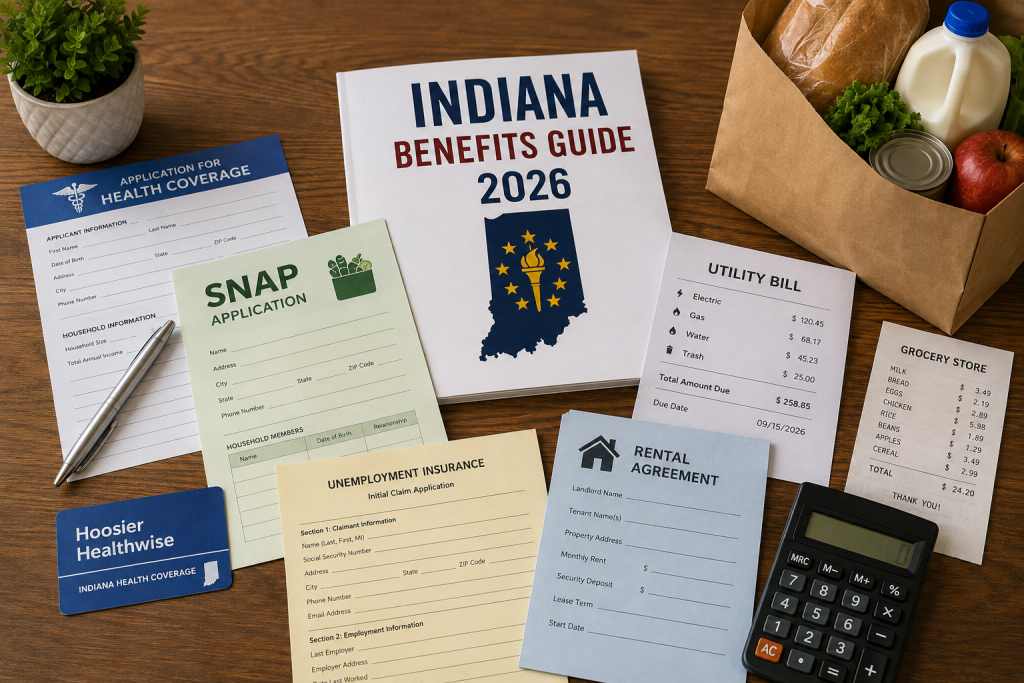
This Indiana benefits guide is for people who need a practical starting point for food assistance, health coverage, cash assistance, utility bill help, affordable housing, and unemployment benefits in Indiana.
Indiana uses several different agencies and online systems for public benefits. SNAP and TANF are administered through the Indiana Family and Social Services Administration, or FSSA. Medicaid applications are also processed through FSSA and the Division of Family Resources. Energy Assistance is managed through the Indiana Housing and Community Development Authority. Housing assistance may involve IHCDA, a local public housing authority, HUD, or Indiana Housing Now. Unemployment benefits are handled by the Indiana Department of Workforce Development.
The application itself is usually only the first step. In real life, many delays happen afterward because a household misses an interview, forgets to upload a requested document, moves without updating an address, overlooks a renewal notice, or stops filing weekly unemployment vouchers while waiting for a decision.
If I were applying for Indiana benefits today, I would create one folder before opening the first application. I would keep identification, recent income records, rent or mortgage documents, utility bills, health insurance information, household details, screenshots, confirmation numbers, and every letter from an agency in that folder.
Indiana Benefits Guide: Quick Answer
For Indiana SNAP, TANF cash assistance, and Medicaid applications, the main online starting point is the FSSA Benefits Portal.
The portal can also be used to manage existing benefits, review notices, report changes, upload requested documents, check case information, and complete Medicaid redeterminations.
For home energy assistance, check the Indiana Energy Assistance Program. For housing, start with IHCDA Housing Choice Voucher information and HUD Indiana.
For unemployment benefits, use the Indiana Department of Workforce Development unemployment page.
Important: This Indiana benefits guide does not determine eligibility or process applications. Income limits, asset limits, work rules, health coverage requirements, application periods, funding, housing waiting lists, unemployment rules, and document requirements can change. Always confirm current information with the official Indiana or federal agency before applying.
Quick Overview of Indiana Benefit Programs
| Need |
Program or Resource |
Where to Start |
| Food assistance |
SNAP |
FSSA Benefits Portal / DFR |
| Adult health coverage |
Medicaid / Healthy Indiana Plan |
FSSA Benefits Portal |
| Children’s health coverage |
Hoosier Healthwise |
Indiana Medicaid / FSSA |
| Cash assistance |
TANF |
FSSA Benefits Portal / DFR |
| Energy bills |
Energy Assistance Program / LIHEAP |
IHCDA / Local Service Provider |
| Housing assistance |
Housing Choice Voucher / Affordable Housing |
IHCDA / Local PHA / HUD |
| Job loss |
Unemployment Insurance |
Indiana DWD / Uplink |
What I Would Do Before Applying
If I were starting an Indiana benefits application today, I would prepare the following before filling out a form:
- Current mailing address, phone number, and email address
- Names and dates of birth for household members
- Social Security numbers for applicants who have them
- Recent pay stubs and other income records
- Bank or resource information when required
- Rent or mortgage information
- Recent utility bills
- Child care expenses when relevant
- Medical expenses when relevant
- Current health insurance information
- Clear photographs or scans of documents
- A folder for confirmation numbers, screenshots, notices, and deadlines
I would also create an FSSA Benefits Portal account instead of relying only on paper notices. Having an account makes it easier to review correspondence, upload documents, report changes, and monitor the case.
1. SNAP Food Assistance in Indiana
The Supplemental Nutrition Assistance Program, or SNAP, helps eligible Indiana households buy food. Indiana SNAP is administered by the Division of Family Resources under FSSA.
The easiest online starting point is the FSSA Benefits Portal. People who cannot apply online can contact or visit a local Division of Family Resources office.
A common point where applicants get stuck is household information. Indiana may ask for the names, birth dates, and Social Security numbers of people living in the home, along with proof of income, resources, housing expenses, utility costs, and certain other expenses.
If I were applying, I would use current numbers instead of estimating. If rent changed last month, I would use the current rent. If work hours changed recently, I would gather the most recent pay records rather than relying on older income.
Indiana SNAP checklist
- Names of everyone in the household
- Dates of birth
- Social Security numbers for applicants who have them
- Recent gross income records
- Bank or resource information when required
- Rent or mortgage amount
- Electric, gas, water, heating, and other utility expenses
- Court-ordered child support paid, if applicable
- Child care expenses, if applicable
- Out-of-pocket medical expenses for qualifying elderly or disabled household members
Common SNAP problems to watch for
- Household size is reported incorrectly
- Recent income is missing
- Requested verification is not uploaded
- The applicant does not respond to an interview request
- Rent or utility costs cannot be verified
- An old mailing address remains on the case
- A recertification or reporting deadline is missed
- The applicant assumes every grocery item is SNAP eligible
Important 2026 Indiana Smart SNAP Change
Beginning January 1, 2026, Indiana’s Smart SNAP policy restricts the use of SNAP benefits for certain sugary drinks and candy.
This means Indiana shoppers should not assume that an item that was previously SNAP eligible can still be purchased with SNAP in 2026. Check current Indiana Smart SNAP guidance when shopping.
Official starting points:
2. Indiana Medicaid and the Healthy Indiana Plan
Indiana Medicaid provides health coverage through several programs depending on age, income, disability, pregnancy, family status, and other eligibility factors.
The Healthy Indiana Plan, usually called HIP, is one of Indiana’s Medicaid programs for qualifying adults. Other Medicaid categories cover children, pregnant individuals, older adults, and people with disabilities.
Applications are processed through FSSA and the Division of Family Resources. Applicants can apply online through the FSSA Benefits Portal, in person, by mail, or by phone.
If I were applying for Medicaid, I would save the application confirmation and check the Benefits Portal regularly instead of assuming that silence means the application was denied.
Indiana Medicaid checklist
- Full names and dates of birth
- Social Security numbers for applicants who have them
- Current Indiana address
- Household income
- Employer information
- Current health insurance information
- Pregnancy information, when applicable
- Disability information, when applicable
- Citizenship or immigration information when requested and applicable
- Asset or resource information for Medicaid categories that require it
Common Medicaid problems
- Missing a request for verification
- Failing to upload documents by the deadline
- Using an outdated mailing address
- Not completing redetermination
- Not reporting household or income changes
- Assuming every adult with low income automatically qualifies for the same Medicaid category
Healthy Indiana Plan Work Requirements Are Coming
Indiana has announced new work and community engagement requirements for certain Healthy Indiana Plan members and applicants beginning January 1, 2027.
Because requirements and exemptions can change, people with HIP coverage should review official FSSA guidance during 2026 rather than waiting until a renewal notice arrives.
Official starting points:
3. Hoosier Healthwise for Children and Families
Hoosier Healthwise is an Indiana Medicaid program that serves qualifying children and certain pregnant individuals.
A child’s eligibility can be different from a parent’s eligibility. I would never stop after seeing that an adult does not qualify for one Medicaid category. I would still make sure the child is included in the application so Indiana can determine whether the child qualifies for Hoosier Healthwise or another coverage option.
Children’s health coverage checklist
- Child’s full name
- Date of birth
- Current Indiana address
- Parent or guardian information
- Household income
- Existing health insurance information
- Social Security number if the child has one
- Citizenship or immigration information when requested
Common children’s coverage problems
- Leaving a child off the household application
- Assuming the parent’s result automatically applies to the child
- Reporting old income
- Missing verification requests
- Not completing renewal paperwork
- Failing to update the household address
Official starting points:
4. TANF Cash Assistance in Indiana
Temporary Assistance for Needy Families, or TANF, provides cash assistance and supportive services to eligible families with children. The program is designed to help families move toward economic self-sufficiency.
TANF applications are handled through Indiana FSSA and the Division of Family Resources. The same FSSA Benefits Portal used for SNAP can be used to apply for cash assistance.
If I were applying for TANF, I would expect the process to involve more than income verification. Household composition, children in the home, resources, employment circumstances, and program participation requirements can all matter.
Indiana TANF checklist
- Photo identification
- Indiana address
- Household member names
- Dates of birth
- Social Security numbers for applicants who have them
- Proof of income
- Bank or resource information when required
- Information about children in the household
- Child support information when applicable
- Employment and work activity information when requested
Common TANF problems
- Household information is incomplete
- Income or resources cannot be verified
- Documents are not submitted by the deadline
- A required interview or appointment is missed
- Work-related requirements are not completed
- A household change is not reported
- Notices in the Benefits Portal are ignored
Official starting points:
5. Indiana Energy Assistance Program and LIHEAP
Indiana’s Energy Assistance Program, or EAP, is the state’s Low-Income Home Energy Assistance Program. It can help eligible households with heating and electric costs.
The program is administered by the Indiana Housing and Community Development Authority through Local Service Providers.
Current August 2026 EAP Status
The 2025-2026 Indiana Energy Assistance Program application period is currently closed.
IHCDA says applicants should monitor the official Energy Assistance Program page for information about the next program year.
If I were planning to apply when the next season opens, I would start collecting documents before the portal opens. Energy assistance programs can become busy quickly once cold weather approaches.
Indiana EAP checklist
- Proof of household income
- Current utility bills or account statements
- Utility account numbers
- Current lease when required
- Tenant verification when utilities are included in rent
- Household member information
- Disconnection notice when applicable
- Additional documents requested by the local provider
Common EAP problems
- Applying after the application period closes
- Using an old utility statement
- Missing proof of income
- Submitting the application to the wrong Local Service Provider
- Not including lease documentation when utilities are included in rent
- Assuming energy assistance will pay the entire annual utility bill
Official starting points:
6. Housing Assistance in Indiana
Housing assistance in Indiana can involve several different systems depending on where you live and what kind of help you need.
Housing Choice Vouchers, commonly called Section 8, are administered by public housing agencies. IHCDA administers vouchers in many parts of Indiana that are not covered by a local city-based housing authority.
Voucher waiting lists are not always open. Applicants should check current IHCDA and local public housing authority notices before applying.
If I were looking for housing help, I would first decide whether I needed a Housing Choice Voucher, public housing, an affordable apartment, eviction assistance, homelessness services, or temporary rent help.
Housing assistance checklist
- Photo ID
- Household member information
- Proof of income
- Asset information when required
- Current lease
- Current rent amount
- Past-due rent notice when applicable
- Eviction or court paperwork when applicable
- Disability information when relevant
- A reliable mailing address
- Waiting-list application confirmation number
Common housing assistance problems
- The waiting list is closed
- The applicant contacts the wrong housing authority
- The household applies outside the correct service area
- A change of address is not reported
- A waiting-list notice is missed
- The applicant loses the confirmation number
- A scammer asks for money to guarantee Section 8 placement
Indiana Housing Now
Indiana Housing Now is a free online housing search resource that can help people find affordable, accessible, and market-rate rental properties.
Finding an affordable property and receiving a rental subsidy are separate processes, so I would not assume that a property listed through a housing search automatically comes with a voucher.
Official starting points:
7. Indiana Unemployment Benefits
Indiana unemployment insurance provides temporary benefits to eligible workers who lose employment and meet state requirements.
The Indiana Department of Workforce Development uses the Uplink system for unemployment claims.
One of the most important things to understand is that filing the initial unemployment application is not enough. You must continue filing weekly vouchers while requesting benefits.
If I filed a claim today, I would immediately put a repeating reminder on my phone for the weekly voucher. I would not wait for the first payment or approval letter.
Indiana unemployment application checklist
- Valid email account
- Driver’s license or other valid ID
- Current address
- Social Security number
- Date of birth
- Phone number
- Last employer’s name
- Employer mailing address
- Employer phone number
- Dates of employment
- Reason employment ended
- Bank routing and account number if using direct deposit
Weekly unemployment responsibilities
- File a voucher every week
- Report income earned during the week
- Complete required work-search activities
- Keep a written work-search record
- Check Uplink notices regularly
- Respond to requests from DWD
Common unemployment problems
- Filing the initial claim but forgetting weekly vouchers
- Waiting for claim approval before filing vouchers
- Not reporting part-time earnings
- Entering incomplete employer information
- Ignoring Uplink correspondence
- Failing to keep a work-search record
- Missing identity-verification requests
Official starting points:
Indiana Benefits Application Checklist
You will not need every document for every program, but gathering the basics before applying can reduce delays.
- Photo ID
- Current Indiana address
- Reliable mailing address
- Current phone number
- Email address
- Household member names
- Dates of birth
- Social Security numbers for applicants who have them
- Recent pay stubs
- Self-employment records
- Social Security, unemployment, child support, pension, or other income records
- Bank or asset information when required
- Rent or mortgage documents
- Utility bills
- Health insurance information
- Child care expenses
- Medical expenses when relevant
- Disability information when relevant
- Citizenship or immigration documents when requested
- Previous benefit notices
- Application confirmation numbers
Common Reasons Indiana Benefit Applications Get Delayed or Denied
- Household information is incomplete
- Income records are outdated
- Requested verification is missing
- Uploaded documents are unreadable
- An eligibility interview is missed
- The mailing address is wrong
- A renewal or redetermination deadline is missed
- The applicant does not check the Benefits Portal
- An energy assistance application period is closed
- A housing waiting list is closed
- The applicant contacts the wrong housing authority
- An unemployment weekly voucher is missed
A denial does not always mean there are no further options. Read the entire notice. Look for the exact reason, the date of the decision, the deadline to respond, and instructions for supplying documents, requesting a review, or filing an appeal.
Practical Tip: Keep a Benefit Paper Trail
If I had to choose one habit that makes Indiana benefit applications easier, it would be keeping a paper trail.
Save a screenshot after submitting an online application. Download or print the confirmation page. Keep copies of every document you upload. If you mail something, take a photo of it first.
If you call FSSA, DWD, IHCDA, or a housing authority, write down the date, the phone number, and what you were told.
If a notice includes a deadline, put it in your phone calendar immediately.
This may feel unnecessary when everything is going smoothly. But if a document disappears, a case is delayed, or someone says information was never received, those records can become extremely useful.
Frequently Asked Questions
Where do I apply for SNAP in Indiana?
You can apply online through the FSSA Benefits Portal. People who cannot apply online can contact or visit a local Division of Family Resources office.
Can I use the same Indiana Benefits Portal for SNAP, TANF, and Medicaid?
Yes. The FSSA Benefits Portal is used to apply for and manage SNAP, TANF cash assistance, and health coverage.
What changed for Indiana SNAP in 2026?
Indiana began its Smart SNAP policy on January 1, 2026. Current Indiana guidance should be checked before purchasing items that may be restricted under the policy.
What is the Healthy Indiana Plan?
The Healthy Indiana Plan, or HIP, is an Indiana Medicaid program that provides health coverage to qualifying adults.
Where do I apply for TANF in Indiana?
You can apply for Indiana TANF through the FSSA Benefits Portal or contact a local Division of Family Resources office.
Is Indiana Energy Assistance open right now?
As of August 26, 2026, the previous Indiana Energy Assistance Program application period is closed. Check the official IHCDA page for the next application opening.
Where do I apply for Section 8 in Indiana?
Check which public housing authority serves the area where you want to live. IHCDA administers Housing Choice Vouchers in many areas, while some cities and counties have their own housing authorities.
Where can I search for affordable apartments in Indiana?
Indiana Housing Now is a free state-supported rental housing search service. HUD Indiana also provides housing resources.
Do I need to file Indiana unemployment every week?
Yes. After filing the initial claim, continue filing weekly vouchers through Uplink for each week you are requesting benefits.
What should I do if an Indiana benefit application is denied?
Read the official notice carefully. Identify the exact reason for the denial and the deadline for responding or appealing. Follow the review or appeal instructions included with the notice.
Related Guides
Official Indiana and Federal Resources
Disclaimer
FactBob is an independent informational website. We are not a government agency and are not affiliated with the State of Indiana or any federal, state, county, or local government agency.
We do not process benefit applications, determine eligibility, provide legal advice, or guarantee approval for any benefit or assistance program.
Program rules, application systems, income limits, asset limits, health coverage requirements, work requirements, funding, waiting lists, benefit amounts, deadlines, and documentation requirements can change. Always confirm current information directly with the official Indiana agency, federal agency, local housing authority, or authorized program administrator before applying.
Final Thoughts
This Indiana benefits guide is meant to make the first step easier.
For food assistance, start with Indiana SNAP and the FSSA Benefits Portal. For adult health coverage, review Indiana Medicaid and the Healthy Indiana Plan. For children, check Hoosier Healthwise. For family cash assistance, review TANF. For utility bills, check Indiana’s Energy Assistance Program. For housing, check IHCDA, Indiana Housing Now, HUD, and the public housing authority that serves your area. For unemployment, file through Indiana DWD and continue filing weekly vouchers through Uplink.
The first application is only part of the process. Check your online accounts, open every agency notice, complete interviews, respond to verification requests, save confirmation numbers, and record every deadline.
Start with the program that matches your most urgent need, use the official source, and keep a record of every step.
“`